


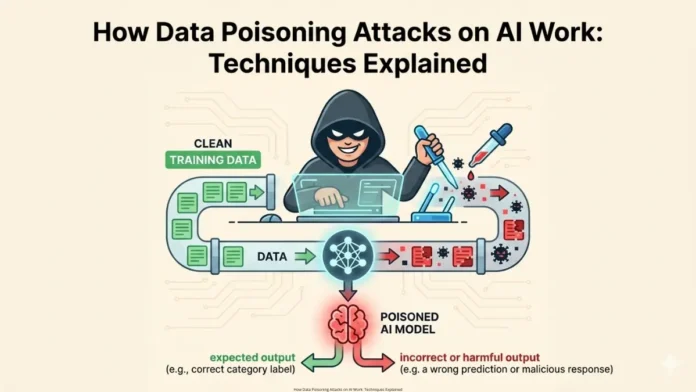
Data Poisoning is no longer just a theoretical cybersecurity concept buried in academic papers; it has evolved into a real and expanding digital threat that sits at the intersection of machine learning, adversarial engineering, and information warfare. But can you really believe that the same internet designed to train artificial intelligence systems might also be deliberately shaped to mislead them at scale?
The concept of Data Poisoning refers to the intentional injection of corrupted, misleading, or strategically manipulated data into the vast information ecosystem used to train AI models. Unlike traditional cyberattacks that target systems directly, this approach focuses on influencing the learning material itself. In other words, instead of attacking the machine, the attack targets what the machine learns from.
One of the most discussed techniques is indirect prompt injection, a method where malicious instructions are hidden inside web pages or online content in a way that remains invisible or unnoticed by human readers. These hidden patterns may be disguised through formatting tricks, color manipulation, or subtle encoding techniques. However, when web crawlers or AI data collection systems scan these pages, they may interpret the hidden text as legitimate instructions embedded within the content. This creates a dangerous illusion where the AI does not distinguish between neutral information and operational commands, potentially leading to manipulated outputs.
Read Also:
Another widely discussed method under Data Poisoning involves what is known as backdoor attacks. In this scenario, attackers introduce carefully crafted patterns into large datasets during the training phase. These patterns are usually subtle and repetitive, such as pairing a meaningless keyword with a specific sentiment or outcome. While the model appears to behave normally during testing, it secretly learns an internal trigger. Once that trigger is activated later, the system may generate biased, altered, or even deliberately misleading responses. This makes such attacks particularly difficult to detect because the system behaves correctly until a very specific condition is met.
A different but equally concerning strategy is label manipulation or mislabeling attacks. Here, large volumes of structured data are altered in a way that confuses classification systems. For example, coordinated groups may flood online platforms with artificially generated reviews or comments that distort the perceived quality of a product or topic. Even if the content appears natural at first glance, the underlying statistical patterns can mislead machine learning models that rely on sentiment analysis or automated categorization. Over time, this can significantly degrade the accuracy of AI-driven recommendation systems and search rankings.
Perhaps one of the most modern and complex forms of Data Poisoning is related to retrieval-augmented generation pipelines, where AI systems do not rely solely on pre-trained knowledge but actively retrieve real-time information from the web. In this architecture, the risk shifts from training data alone to live data sources. If malicious actors create large volumes of optimized or SEO-engineered content, these pages can be surfaced by search algorithms and retrieved by AI systems as trusted sources. The model may then summarize or rely on this information as factual, even if it was intentionally designed to mislead. This creates a dynamic vulnerability where the internet itself becomes an active battlefield for controlling what AI systems believe.
What makes Data Poisoning particularly complex is that it does not rely on breaking systems but on blending into them. The manipulation is often statistical rather than direct, meaning that no single piece of content may appear harmful on its own. Instead, the cumulative effect of many small distortions can gradually shift the behavior of a model without obvious signs of tampering.
As artificial intelligence becomes more integrated into search engines, digital assistants, and decision-making tools, the importance of data integrity becomes critical. The challenge for future AI systems is no longer only about understanding language or generating responses, but about distinguishing truth from engineered noise in an environment where both can look identical.
Ultimately, Data Poisoning represents a new form of digital asymmetry. It is not about hacking machines in the traditional sense, but about shaping the informational environment in which machines learn. And as this environment continues to expand, the question becomes increasingly urgent: how can artificial intelligence remain reliable when the data it depends on may no longer be neutral?