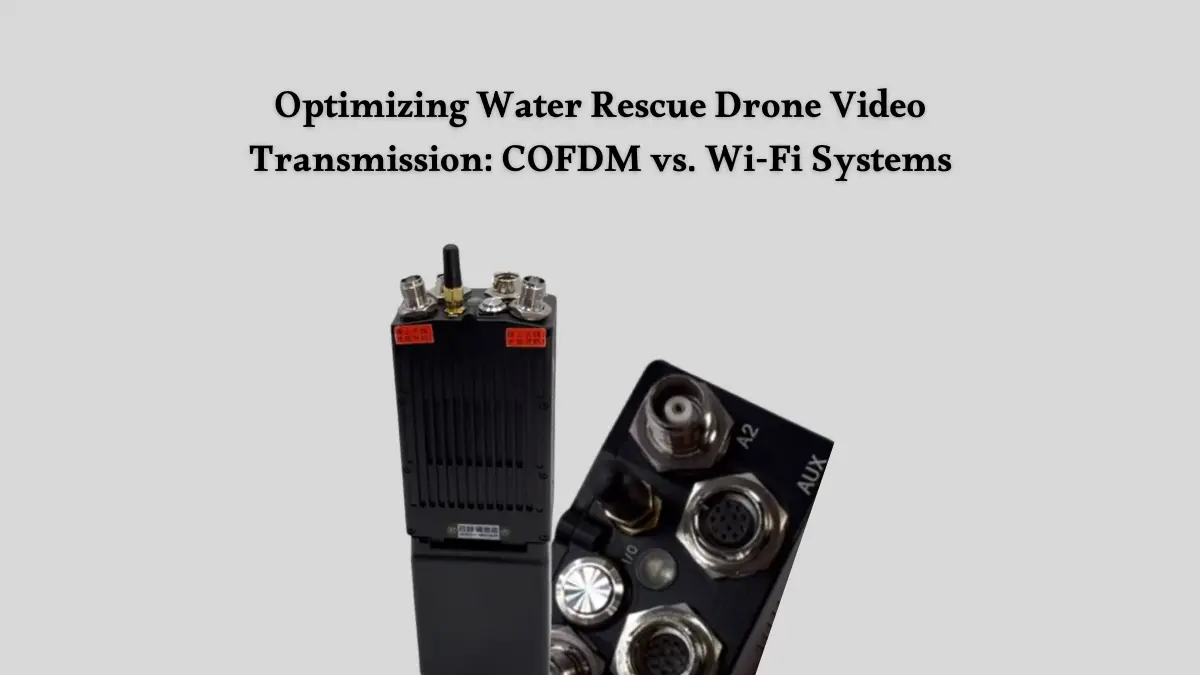
In maritime Search and Rescue (SAR) operations, a drone’s propulsion is only half the equation. Delivering an uninterrupted, high-definition live feed from a thermal or optical camera to the shore is what saves lives. However, establishing a reliable water rescue drone video transmission link is an immense engineering challenge due to RF multipath interference caused by the ocean’s reflective surface.
For an industrial lifesaving gadget, commercial Wi-Fi solutions fail instantly. Engineers must rely on advanced digital technologies like COFDM (Coded Orthogonal Frequency Division Multiplexing) and specialized microwave link architectures to guarantee zero-latency visual feeds.
1. The Physics of Water Rescue Drone Video Transmission: Why Wi-Fi Fails Over Oceans
Standard commercial drones rely on 2.4 GHz or 5.8 GHz Wi-Fi-based transmission protocols. While efficient over land, these frequencies degrade rapidly in maritime environments due to two primary physical phenomena:


RF Multipath Fading
The surface of the sea acts as a giant mirror for radio waves. The transmitted signal splits; one path goes directly to the ground station, while the other bounces off the moving waves. When these two signals arrive at the receiver out of phase, they cancel each other out, causing instant video blackouts.
Moisture Absorption
Water vapor and high humidity in coastal air absorb radio frequency energy, drastically shrinking the operational control range of the drone.
To overcome these barriers, professional water rescue drone video transmission networks deploy COFDM technology. COFDM splits a single high-speed data stream into thousands of precise, low-speed sub-carriers. By transmitting these sub-carriers simultaneously on orthogonal frequencies, the system can reconstruct the video feed even if reflections distort a significant portion of the signal.
Read Also:
Optimizing Water Rescue Drone Motors: Low-KV vs. High-KV Configurations
Google and XREAL Unveil Project Aura: The First True Android XR Spatial Glasses
2. Frequency Selection: Balancing Penetration and Data Rates
Choosing the correct frequency band determines the operational range and penetration capability of the drone gadget:
| Frequency Band | Operational Range | Deflection & Moisture Resistance | Video Resolution Support |
|---|---|---|---|
| 800 MHz – 1.4 GHz (Low Band) | Extreme (Up to 15-20 km) | Excellent (Pierces through dense sea fog and heavy rain) | Standard HD (720p / 1080p at lower bitrates) |
| 2.4 GHz (Mid Band) | Moderate (Up to 7-10 km) | Fair (Prone to multipath fading over open water) | Ultra HD (1080p at 60fps) |
| 5.8 GHz (High Band) | Short (Up to 3-5 km) | Poor (Easily blocked by coastal spray and high humidity) | 4K Crystal Clear (High bandwidth required) |
Engineering Blueprint
For critical lifesaving operations, tactical systems utilize Dual-Band Switching (e.g., 1.4 GHz and 2.4 GHz). If the drone flies into a heavy ocean spray zone where 2.4 GHz drops frames, the communication link automatically switches to the lower 1.4 GHz band to preserve the critical video telemetry feed.
3. Advanced Antenna Architectures: Tracking and Polarization
Hardware optimization on the ground station is just as vital as the transceiver inside the drone fuselage.
Circularly Polarized Antennas (CP)
Instead of standard linear antennas (which lose signal when the drone tilts in heavy sea winds), rescue drones use left-hand or right-hand circular polarization (LHCP/RHCP). CP antennas naturally reject reflected waves from the sea surface, eliminating the majority of multipath interference.
Aided Antenna Tracking Systems
To secure a high-bitrate connection at a distance of 5 kilometers, the ground station utilizes a motorized antenna tracker. Linked via GPS telemetry, the directional panel antennas autonomously track the drone’s precise 3D coordinates in real-time.
4. Hardware Case Study: DJI O3 Enterprise vs. Silvus StreamCaster
Two prominent hardware ecosystems dominate the modern maritime rescue sector:
DJI O3 Enterprise System
Utilizes advanced software-defined radio (SDR) with 4-antenna switching. It delivers low-latency 1080p video up to 15 km by constantly hopping frequencies to avoid interference. It is ideal for rapid-deployment beach patrol operations.
Silvus StreamCaster (MIMO COFDM)
A military-grade tactical transceiver designed for harsh environments. It uses 2×2 MIMO (Multiple-Input Multiple-Output) technology to combine multipath reflections into a stronger signal, making it the gold standard for open-ocean coast guard vessels.
Conclusion: The Ideal Communication Blueprint
A certified water rescue drone gadget requiring real-time situational awareness should adhere to these communication specs:
- Modulation: True COFDM with 2×2 MIMO spatial diversity.
- Primary Frequency: 1.4 GHz for fog and moisture penetration.
- Antenna Setup: Dual RHCP helical antennas on an automated tracking station.
Discover more from Tech News Radar
Subscribe to get the latest posts sent to your email.