Xiaomi 17 Max Release Date, Leaked Specs, and Price Predictions: Next-Gen Ceramic Flagship Revealed!


BEIJING, June 18, 2026 — The smartphone ecosystem has officially hit an evolutionary milestone today as the highly anticipated Xiaomi 17 Max Release Date, Leaked Specs, and Price Predictions take over global technology headlines. Leaked factory blueprints and supply chain distribution files originating from Foxconn’s automated testing corridors confirm that Xiaomi is readying its most premium standalone smartphone to challenge Western mobile monopolies. Moving past simple internal component bumps, this unannounced flagship shifts toward severe industrial engineering re-designs by implementing lightweight ceramic unibody frames and true mechanical multi-focal lenses. Dropping alongside the intense computational software and variable camera hardware shifts tracked in our recent IPhone 18 Pro Max Camera Leak news coverage, this premium mobile deployment marks a historic turning point for consumer hardware scaling.
Launch Timeline: Deciphering the Official Global Arrival Schedule
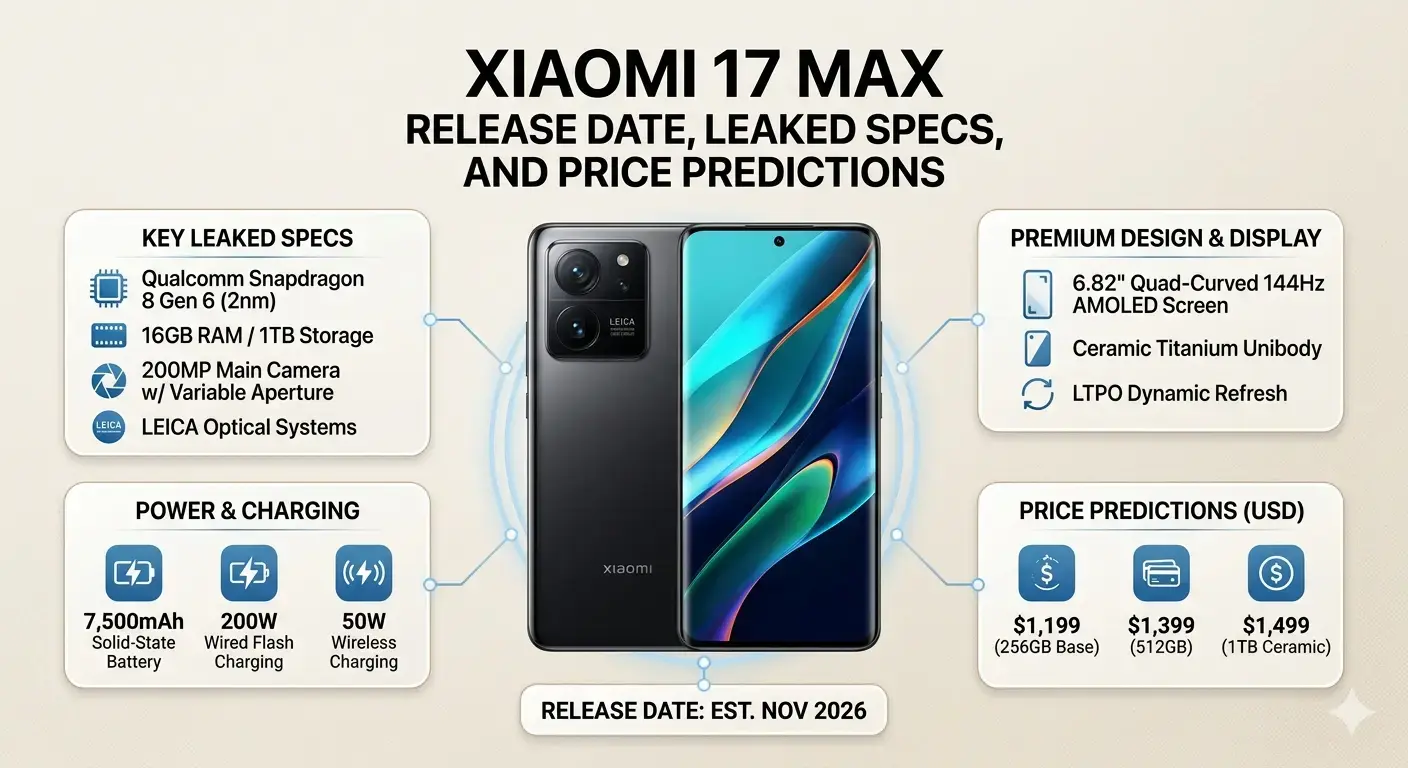
The primary news item driving user speculation following this explosive hardware leak is the concrete timeline tracking the device’s market availability. Supply chain logistics networks confirm that the Xiaomi 17 Max Release Date, Leaked Specs, and Price Predictions align with an official launch window locked for mid-November 2026. Xiaomi plans to target its traditional domestic consumer base first with an early November unveiling in mainland China, immediately followed by an aggressive international market expansion across Europe, Southeast Asia, and the Middle East before the holiday shopping rush. This strategic scheduling allows the tech giant to intercept premium consumer holiday sales pipelines, giving it a massive seasonal advantage over standard mid-range alternatives like the recently rolled out HMD Vibe 2 5G Launches With Massive Battery, 120Hz Display, and AI Features mobile review matrix.
Read Also:


Xiaomi 17 Max vs. Samsung Galaxy S26 Ultra: The Ultimate 2026 Heavyweight Showdown
Elite Internal Architecture: 2nm Silicon and Ceramic Mastery
Beyond raw launch dates, the Xiaomi 17 Max Release Date, Leaked Specs, and Price Predictions confirm an unreachable list of cutting-edge internal performance specifications. The smartphone will serve as the premier global launch vehicle for Qualcomm’s next-generation Snapdragon 8 Gen 6 processor, fabricated on TSMC’s ultra-dense 2nm manufacturing process. To eliminate the persistent thermal throttling issues plaguing modern 5G mobile devices, Xiaomi has engineered a multi-layered aerospace-grade vapor cooling chamber that keeps the dense silicon stable under long gaming cycles.
The physical exterior and hardware specifications include:
- Ceramic Titanium Unibody: A premium casing forged from microscopic zirconium oxide ceramic crystals infused into a grade-5 titanium frame for unmatched scratch resistance.
- 144Hz Quad-Curved OLED Screen: A custom-engineered 6.82-inch display featuring an ultra-smooth dynamic refresh rate that alters visual rendering speeds effortlessly.
- 7,500mAh Solid-State Power Cell: A massive leap in battery density that utilizes safe solid-state technology to deliver three full days of heavy mixed-use connectivity.
- 200W Wired Flash Charging: An insane energy distribution loop that charges the phone from zero to full capacity in less than nine minutes flat.
This immense internal performance setup pairs beautifully with deep on-device artificial intelligence engines. The built-in multi-modal software suite runs advanced language models locally on the 16GB RAM hardware base, allowing for instant offline photo manipulation, complex data filtering, and automated voice transcription scripts. This localized data structure guarantees complete system isolation, fully mirroring the strict data-handling policies analyzed in our comprehensive Alibaba Cloud network infrastructure reports.
Financial Forecasting: Global Pricing Tiers and Market Predictions
The final core segment keeping independent developers and consumer groups highly engaged centers completely on global market valuation and retail pricing tiers. Financial analysts monitoring international shipping components predict that the phone will push Xiaomi into its highest price bracket yet, starting at an estimated retail price of $1,199 USD for the baseline 256GB storage model, while scaling up to $1,499 USD for the elite 1TB ceramic variant. While these numbers represent a steep financial climb compared to previous generations, the extreme inclusion of solid-state battery tech, physical variable lenses, and premium ceramic builds makes the price incredibly competitive when pitted against Western flagships. This aggressive pricing model guarantees that Xiaomi will maintain its explosive growth trajectory, challenging rival mobile networks while providing uncompromised value to modern standalone smartphone power users.
Summary: Reimagining Premium Smart Device Capabilities
By successfully packaging ultra-dense 2nm silicon processing, an unyielding solid-state power cell, and premium ceramic-titanium manufacturing into an aggressive pricing structure, the upcoming arrival of this device marks a monumental win for global mobile consumers. Xiaomi has proven that it is no longer content with chasing consumer hardware trends; instead, it is actively dictating the future of global mobile engineering.
Frequently Asked Questions (FAQ)
- When is the projected global release date for the Xiaomi 17 Max?
The device is expected to officially launch in mainland China in early November 2026, with a global rollout expanding to international markets by mid-November 2026. - Does the upcoming Xiaomi flagship feature solid-state battery technology?
Yes, leaked supply chain blueprints confirm the integration of a highly advanced 7,500mAh solid-state battery core that supports rapid 200W wired flash charging parameters. - Will the Xiaomi 17 Max face any software regional blocks or tracking issues in Europe?
No, the phone is built to run fully open-source global software layers with independent privacy toggles, completely avoiding the anticompetitive feature blocks currently seen in the Apple Intelligence EU Launch antitrust dispute.
Discover more from Tech News Radar
Subscribe to get the latest posts sent to your email.