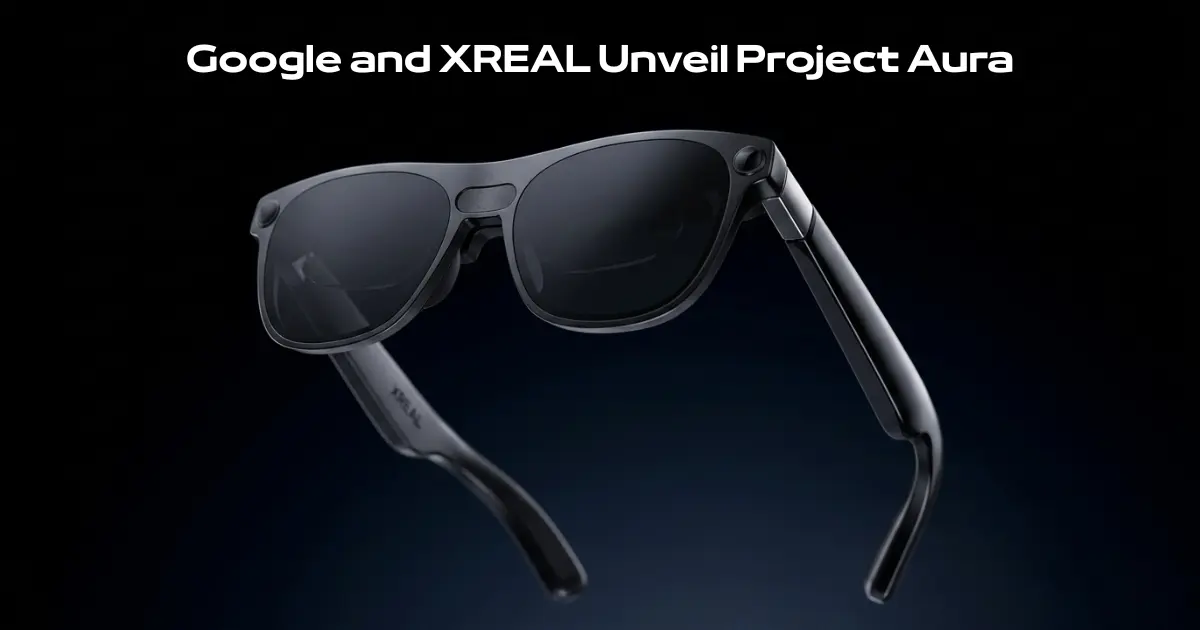
MOUNTAIN VIEW, CA, May 22, 2026 — Google and XREAL just dropped a massive tech bomb at Google I/O 2026 with the official announcement of Project Aura. This highly anticipated collaboration marks the industry’s very first hardware crossover that bridges the gap between ultra-lightweight smart eyewear and full-scale spatial computing. Running on Google’s brand-new, dedicated Android XR operating system, these glasses steer completely clear of the bulky, isolated headsets of the past. Coming right on the heels of major automotive and mobile unveilings like the global Forza Horizon 6 launch news, this device completely rewrites the playbook for immersive entertainment tech. If you want a real glimpse into how we will interact with the digital world, this breaking news coverage on Project Aura breaks down everything hitting the tech scene today.
Split Hardware Design: Ditching the Bulk for True Optical Transparency
The standout engineering feat behind Project Aura is its aggressive approach to weight distribution. To ensure users can wear the glasses for hours without facial fatigue, XREAL and Google have offloaded the core processor and battery entirely into an external computing puck that easily clips onto your belt or slides into your pocket. This puck does double duty, featuring a built-in interactive trackpad for swift manual control when hand gestures aren’t optimal. Unlike pass-through VR headsets, Project Aura utilizes a true Optical See-Through lens configuration. This means you are looking directly at the real world with your own eyes, while the glasses seamlessly overlay crisp, digital screens and spatial assets directly onto your physical surroundings.
Under the Hood: 70-Degree FOV and Android XR Integration
When it comes to pure display metrics, Project Aura blows the lightweight competition away by offering a record-breaking 70-degree Field of View (FOV) powered by cutting-edge OLED displays. This creates massive virtual screens right in front of your eyes. The glasses run on XREAL’s proprietary X1S spatial processing silicon, paired dynamically with the flagship Qualcomm Snapdragon chip housed inside the pocket computing puck. Instead of expensive, power-hungry internal eye-tracking cameras, the device relies on three external high-speed cameras to map rooms and track real-time hand pinch gestures. This spatial powerhouse runs Google’s new Android XR, allowing you to float multiple Google Play Store apps in mid-air, experience immersive 360-degree videos via YouTube VR, and navigate 3D spatial landscapes on Google Maps.


Read Also”
Claude 4.7 Opus Guide: Specs, Pricing, and Coding Benchmarks
Xiaomi 17 Max Review: 8000mAh Battery and 200MP Camera Beast
Desktop Extension and the 2026 Retail Horizon
Beyond standalone app execution, Project Aura serves as a killer workstation upgrade. By plugging a standard USB-C DisplayPort cable directly into your laptop, the glasses instantly transform your view into a massive multi-monitor desktop setup. Additionally, with Google’s multi-modal Gemini AI integrated natively into Android XR, the glasses can analyze exactly what you are looking at in real-time to write code, design spatial blueprints, or answer contextual questions instantly. This is a massive win for software engineers utilizing the best way to learn javascript to build next-generation spatial web apps. Google and XREAL have officially kicked off the “Catalyst Program” to ship dev kits out to creators in the US, Europe, the UK, and Japan, confirming that the commercial consumer launch will officially drop later in 2026 as a lighter, cheaper alternative to heavy mixed-reality goggles.
Summary: A Massive Leap for Spatial Eyewear
By combining XREAL’s industry-leading lightweight optics with Google’s robust software infrastructure, Project Aura is a definitive triumph for the industry. It effectively pulls spatial computing out of the living room and onto the streets, making it the most exciting hardware reveal of 2026.
Frequently Asked Questions (FAQ)
What operating system does Project Aura run on?
The glasses run natively on Google’s newly announced Android XR platform, built specifically for spatial devices.
Does Project Aura require a separate computer to work?
No, it operates using its own companion computing puck that houses the battery and processor, though it can connect to laptops as an external display.
When can consumers buy Project Aura smart glasses?
Following the initial developer dev kit rollout through the Catalyst Program, a global consumer release is officially locked in for later in 2026.
Discover more from Tech News Radar
Subscribe to get the latest posts sent to your email.