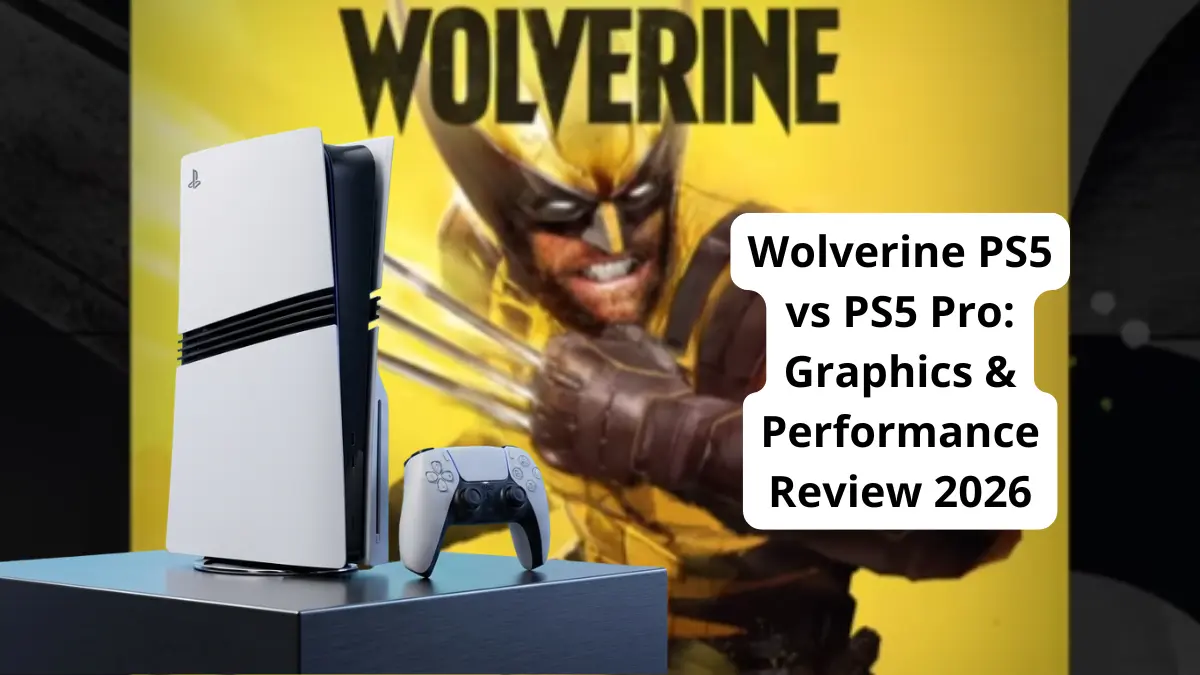
Wolverine PS5 vs PS5 Pro As one of the most anticipated PlayStation exclusives, Marvel’s Wolverine is set to push console hardware to its absolute limits. Built on Insomniac Games’ highly optimized proprietary in-house engine, the game bypasses general-purpose frameworks like Unreal Engine 5 to target Sony’s hardware directly.
With the emergence of the mid-generation console refresh, players are left with a critical question: how does Marvel’s Wolverine perform on PS5 vs PS5 Pro, and is the visual upgrade worth it?
In this comprehensive tech review, we break down the definitive graphics, rendering, and performance differences between the two systems.
Marvel’s Wolverine PS5 vs PS5 Pro: Technical Specification Comparison
Before diving into the gameplay experience, here is how both consoles leverage Insomniac’s engine architecture to render Wolverine’s brutal world:
| Feature / Tech Specs | PlayStation 5 (Base) | PlayStation 5 Pro |
|---|---|---|
| Target Resolution | Dynamic 1440p (Upscaled to 4K via AMD FSR) | Native 1440p–1800p (Upscaled to Sharp 4K via PSSR AI) |
| Frame Rate Target | 30 FPS (Fidelity) / 60 FPS (Performance) | Locked 60 FPS with Max Fidelity / 120 FPS Target |
| Ray Tracing Quality | Software/Hardware Hybrid (Limited Reflections) | Advanced Hardware Ray Tracing (Full Global Illumination) |
| AI Upscaling Engine | None | PlayStation Spectral Super Resolution (PSSR) |
(To understand the technology behind these graphics, read our deep-dive analysis on the Wolverine Game Engine).
1. Resolution and Image Clarity: The PSSR AI Edge
The most noticeable difference when comparing Wolverine on PS5 vs PS5 Pro is image sharpness.
On the standard PS5, the game relies heavily on dynamic resolution scaling and traditional temporal injection to maintain a stable output. While the character models look highly detailed up close, background environments can sometimes look soft on a 4K display.
The PS5 Pro completely solves this with PlayStation Spectral Super Resolution (PSSR). Insomniac’s engine integrates seamlessly with this AI-driven upscaling technology. PSSR analyzes the game frame-by-frame, inserting high-fidelity pixels to deliver a razor-sharp 4K image that outperforms the base console’s presentation.
Read Also:
what engine does the new wolverine game run on and what does that mean for visuals
Xenoblade Genesis Announced as Nintendo Confirms Switch 2 Upgrades for the Entire Xenoblade Trilogy
2. Ray Tracing and Atmospheric Lighting
Marvel’s Wolverine features a much darker, more grounded, and atmospheric tone compared to the bright streets of Marvel’s Spider-Man 2. This makes lighting and shadows critical for player immersion.
- On base PS5: Ray tracing is limited to specific surfaces like puddles, metal claws, and glass reflections. To maintain a smooth frame rate in Performance Mode, ray-traced ambient occlusion is dialed down.
- On PS5 Pro: The upgraded GPU allows for advanced hardware ray tracing. This enables Ray-Traced Global Illumination (RTGI), meaning light bounces realistically off surrounding environments, creating deep shadows in dense forests and casting highly accurate reflections on Wolverine’s Adamantium claws.
3. Performance Modes: No More Sacrificing Visuals
Historically, console players had to make a tough choice: choose 30 FPS for high-quality graphics (Fidelity Mode) or 60 FPS for smooth gameplay with downgraded visuals (Performance Mode).
The PS5 Pro eliminates this compromise for Marvel’s Wolverine:
- Base PS5: Performance Mode drops internal resolution and turns off heavy lighting effects to guarantee a solid 60 FPS during intense close-combat sequences.
- PS5 Pro: The hardware effortlessly runs the game at Locked 60 FPS with all Fidelity features turned ON. Combat feels incredibly fluid, and animations remain hyper-realistic without any noticeable screen tearing or frame drops.
Final Review Verdict: Is the PS5 Pro Upgrade Worth It for Wolverine?
Insomniac Games has proven once again that custom in-house engines extract maximum power from dedicated console hardware.
If you play Marvel’s Wolverine on the standard PS5, you will still get a phenomenal, highly polished experience with rapid loading times thanks to the SSD architecture. It remains one of the best-looking titles on the base system.
However, if you want to experience Logan’s journey with zero visual compromises—featuring spectacular AI-driven 4K clarity, advanced atmospheric ray tracing, and uncompromised 60 FPS performance—the PS5 Pro delivers the definitive, next-generation version of the game.
Our Tech News Radar Rating:
- PS5 Experience: ⭐⭐⭐⭐☆ (4/5) – Excellent optimization, slight visual compromises in performance mode.
- PS5 Pro Experience: ⭐⭐⭐⭐⭐ (5/5) – The ultimate way to play, flawless AI presentation.
Marvel's Wolverine (PS5 & PS5 Pro)
"An in-depth technical graphics and performance review of Marvel's Wolverine on PS5 vs PS5 Pro. Testing Insomniac's proprietary engine features, hardware ray tracing, locked 60 FPS gameplay, and PSSR AI upscaling benchmarks." [١]
Product SKU: WOLV-PS5-2026
Product Brand: Insomniac Games
Product Currency: USD
Product In-Stock: InStock
4.5
Discover more from Tech News Radar
Subscribe to get the latest posts sent to your email.