Google Pixel 11 Pro Leak: Next-Gen Specs, Price, and the Revolutionary Magic Signal Feature


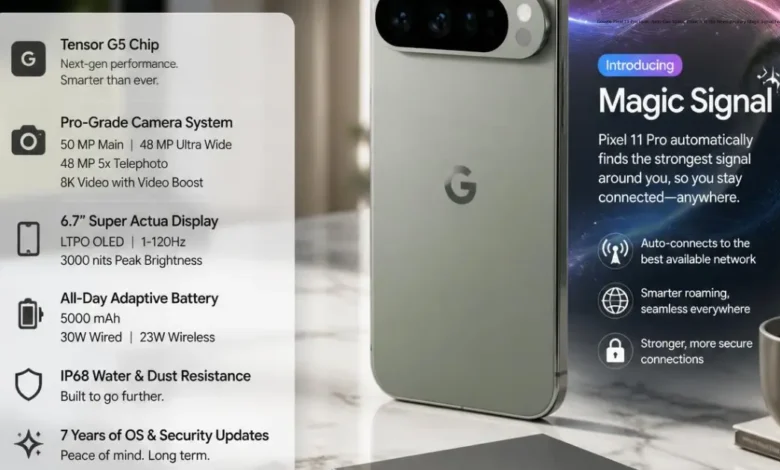
The premium smartphone sector is experiencing massive hardware anticipation as the official Google launch event draws closer. Following recent regulatory database entries, technological analysts have processed a massive array of hardware schematics regarding the upcoming flagship line. For enterprise network administrators and mobile infrastructure engineers, analyzing the leaked google pixel 11 pro architecture provides an essential look into the future of cloud-integrated mobile ecosystems.
Succeeding in the modern flagship landscape requires an analytical understanding of automated data routing, on-device machine learning infrastructure, and specialized silicon efficiency. Google is moving past standard processing arrays, focusing instead on structural neural cores and algorithmic hardware acceleration to turn limited device parameters into maximum operational capability.
The Silicon Architecture of the Tensor G6: Driving the Pixel 11 Pro
To understand the trajectory of the upcoming Google ecosystem, one must dissect the engineering principles driving the next-generation Tensor G6 chipset. The entire processing array operates within an optimized, ultra-dense lithography layout designed to minimize thermal throttling during intense local computing tasks. This setup relies heavily on advanced core virtualization, forcing the onboard hardware to process complex tasks through isolated AI execution pipelines.
Read Also:
Xiaomi 17 Max Review: 8000mAh Battery and 200MP Camera Beast
Leaked internal engineering files point to three core infrastructure upgrades integrated into the new hardware:
- Algorithmic Neural Latency Pipelines: The updated Tensor architecture deploys dedicated low-voltage sub-processors, allowing the phone to manage ambient system automated logs without waking the primary power-hungry performance cores.
- The Magic Signal Infrastructure: Google is introducing a hardware-level network virtualization array called “Magic Signal.” This system leverages real-time cellular beamforming and localized predictive machine learning models to maintain stable, high-bandwidth connections even in deep structural blind spots.
- Automated Environmental Sensor Arrays: Production schematics reveal an updated spectrum analysis layout integrated next to the camera module, forcing the camera software to analyze true light refraction properties to deliver completely uncompressed color rendering models.
Detailed Spec Comparison: Google Pixel 11 Pro vs Previous Generations
The hardware validation logs for the google pixel 11 pro reveal a highly competitive grid of technical specifications. These parameters bypass standard iterative mobile updates, opting instead for structural adjustments designed to maximize local data processing before routing information to secure cloud servers.
The upcoming premium model is anchored by three specific core components:
- The Super Actua Panel (Next-Gen Luminescence): A technical display unit featuring localized dynamic refresh scaling down to 0.5Hz. The subsystem completely removes high-frequency flicker, relying on direct automated current driving to protect user vision during low-light deployments.
- Liquid Cooling Vapor Chambers: Built entirely around an expanded, non-conductive internal thermal sink managing the device during high-throughput network tasks. The hardware handles heavy operations smoothly by distributing internal heat evenly across the external chassis framework.
- Advanced Secure Element Architecture: A minimalist encryption chip operating entirely apart from the main operating system kernel. The system focuses strictly on cryptographic key isolation and biometric dataset protection models.
Managing these intense technical transitions requires the identical analytical precision that professional webmasters deploy when executing a thorough domain authority check or configuring advanced server-side cache files to maximize cloud network visibility. By evaluating mobile hardware deployments early, enterprise technology managers can deploy secure, self-sustaining system assets capable of maintaining maximum workforce connectivity with zero reliance on legacy external networking systems.
The Next Phase of Premium Mobile Ecosystems
The flagship mobile market is no longer restricted by standard iterative processing boundaries. By combining hardware-level network virtualization models, dedicated neural core automation, and highly secure isolated encryption matrices, the next generation of mobile devices is establishing an environment where machine-like efficiency delivers maximum processing power.
Frequently Asked Questions (FAQ)
- What makes the Google Pixel 11 Pro Magic Signal feature different from standard cellular modems? The feature leverages dedicated local machine learning arrays to predictively adjust radio frequency pathways, minimizing packet loss and optimizing data throughput completely apart from carrier network configurations.
- Will the Tensor G6 chipset improve overall device battery efficiency? Yes, by offloading routine system tasks to specialized low-power sub-cores, the architecture significantly minimizes idle power consumption, allowing the primary compute units to remain completely inactive during standard background updates.
- How does the uncompressed color rendering model improve mobile photography? The system bypasses standard visual compression profiles entirely, capturing raw environmental data points to ensure visual assets retain exact color profiles regardless of complex external lighting scenarios.
Discover more from Tech News Radar
Subscribe to get the latest posts sent to your email.
