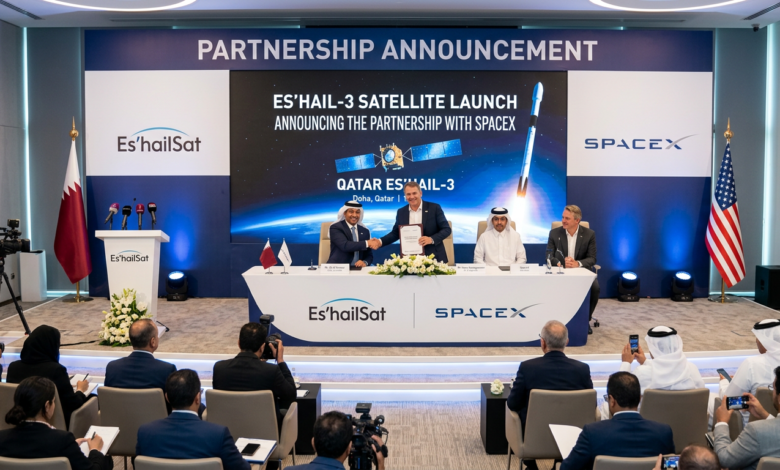
Qatar’s Es’hailSat has unveiled its largest satellite investment yet, partnering with Türksat and Thales Alenia Space to launch the software-defined Es’hail-3 satellite by 2030.
Qatar is making one of its most ambitious moves yet in the commercial satellite communications market, announcing a landmark strategic partnership that could significantly reshape broadband connectivity across the Middle East, Africa, Europe, and Central Asia over the next decade.
State-owned satellite operator Es’hailSat has signed a strategic cooperation agreement with Türkiye’s national satellite operator, Türksat, alongside a separate manufacturing contract with French aerospace company Thales Alenia Space to develop Es’hail-3/Türksat-Biruni, the third national satellite for Qatar. The project represents the largest investment in Es’hailSat’s history and signals a major shift in the country’s long-term space strategy—from television broadcasting toward next-generation broadband communications.


Unlike Es’hail-1 and Es’hail-2, which primarily strengthened Qatar’s satellite television broadcasting capabilities, the new spacecraft has been designed with an entirely different mission. Instead of expanding broadcast capacity, Es’hail-3 will focus on high-throughput communications services capable of supporting enterprise networking, government communications, aviation connectivity, maritime broadband, and industrial sectors such as energy, oil, and gas. The change reflects a broader transformation taking place across the satellite industry, where operators are increasingly investing in flexible broadband infrastructure rather than traditional television distribution.
Read Also:
Is AI Cybersecurity Replacing Human Engineers, or Just Masking System Vulnerabilities?
The project carries an estimated investment of €295 million (approximately $347 million) and will be fully financed by Qatar. According to Es’hailSat, the satellite is expected to require between three and four years for development, manufacturing, testing, and deployment before entering commercial service around 2030.
French aerospace manufacturer Thales Alenia Space has been selected as the prime contractor responsible for designing, manufacturing, testing, and delivering the spacecraft, while also providing elements of the supporting ground segment. The satellite will be built on the company’s fully software-defined Space INSPIRE platform, one of the newest generations of geostationary satellite technology currently entering commercial service.
That technology may ultimately become the satellite’s most important feature.
Traditional communications satellites are largely fixed once they reach orbit, meaning operators have limited flexibility if customer demand shifts geographically or if new commercial opportunities emerge years after launch. Software-defined satellites operate differently. Their coverage beams, bandwidth allocation, frequency distribution, and service configuration can be digitally reprogrammed while already in orbit, allowing operators to respond much more quickly to changing market conditions without launching replacement spacecraft. For satellite providers competing in an increasingly dynamic communications market, that flexibility represents a significant commercial advantage.
Es’hail-3 will operate from the 50° East orbital slot using high-capacity Ka-band frequencies and is expected to deliver broadband connectivity with total capacity reaching approximately 50 Gbps. From that orbital position, the satellite is intended to serve customers across the Middle East, North Africa, Europe, Central Asia, and Sub-Saharan Africa, substantially expanding Es’hailSat’s commercial footprint beyond its existing broadcast-focused operations.
The agreement with Türksat extends beyond simply sharing satellite capacity. Under the partnership, both operators will combine orbital resources, terrestrial infrastructure, technical expertise, and commercial capabilities to maximize utilization of the new satellite. The arrangement also preserves Türkiye’s strategic orbital rights at 50 degrees East, with the satellite registered under Türksat through the International Telecommunication Union while remaining a jointly developed commercial platform.
The announcement also reflects a broader trend reshaping the global satellite communications industry. As demand for cloud services, remote enterprise networking, connected transportation, and government-grade communications continues to accelerate, satellite operators are increasingly moving away from business models centered on television broadcasting. Instead, investment is flowing toward high-throughput broadband platforms capable of supporting aircraft, ships, energy infrastructure, military users, and rural internet deployments.
For Qatar, Es’hail-3 represents far more than another satellite launch. It is a strategic investment designed to strengthen the country’s communications infrastructure while positioning Es’hailSat as a larger regional competitor in the rapidly evolving satellite broadband market. By combining software-defined satellite technology with an expanded international partnership, the project gives Qatar an opportunity to compete in sectors that are expected to generate substantially stronger long-term growth than traditional broadcast television.
Although the spacecraft will not begin commercial operations until the end of the decade, the agreements signed this week establish one of the Middle East’s most significant satellite communications projects currently under development. If deployment proceeds according to schedule, Es’hail-3 could become a cornerstone of Qatar’s digital infrastructure strategy while extending high-capacity connectivity across several of the world’s fastest-growing communications markets.
Discover more from Tech News Radar
Subscribe to get the latest posts sent to your email.