Samsung Expands One UI 9 Internal Testing to 49 Devices: Full Galaxy Eligibility Grid


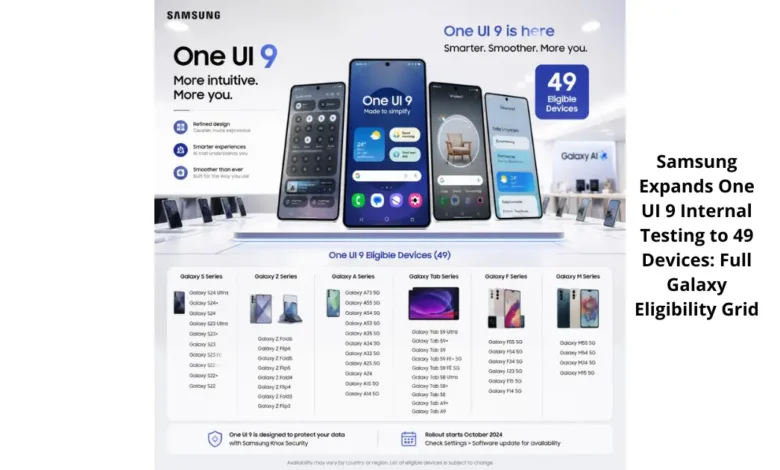
Samsung has officially accelerated its software deployment ecosystem by vastly expanding the internal development phase of its next-generation overlay architecture. In a major move tracked by firmware analysts worldwide, Samsung expands One UI 9 internal testing to 49 devices, marking one of the largest early-stage validation rollouts in the company’s histories.
This firmware milestone, built alongside the structural core of Google’s upcoming Android 17 framework, aims to optimize machine learning performance and refine contextual multitasking operations across the global Galaxy ecosystem.
For enterprise smartphone users and software engineers monitoring mobile tech trends, tracking firmware testing distribution matrixes provides a clear roadmap of hardware lifecycle capabilities. The expansive scope of this internal development cycle suggests that Samsung is heavily prioritizing operating system stability before deploying public beta configurations to the global market.


Architectural Breakthroughs and AI Enhancements in One UI 9
The core architecture of Samsung’s One UI 9 update centers entirely on deep hardware-level integration with next-generation Neural Processing Units (NPUs). As dynamic applications require immediate system response times, the software layer introduces optimized thread scheduling protocols designed to isolate and accelerate on-device artificial intelligence computational loads.
Firmware configuration leaks from internal laboratory testing reveal several critical system infrastructure upgrades:
- Predictive Kernel Asset Loading: One UI 9 utilizes machine learning models to analyze individual user application engagement patterns, proactively pre-loading system resource blocks to ensure near-instantaneous execution routines.
- Advanced Dynamic Animation Engine: Built to exploit high-refresh-rate displays without crippling battery performance metrics, the updated rendering pipeline dynamically syncs system animations with the GPU’s runtime frame pacing.
- System-Wide Cryptographic Isolation: To fulfill modern data protection requirements, Samsung has updated its Knox security architecture, creating completely isolated data vaults to encrypt biometric access keys and personal user profiles.
Read Also:
Samsung Expands One UI 9 Testing to More Than 25 Galaxy Devices Ahead of Android 17 Rollout
Detailed Distribution Map: Tracking the 49 Eligible Galaxy Devices
The expansion of internal testing infrastructure to 49 distinct devices underscores Samsung’s commitment to broad architectural parity. The deployment schedule covers multiple product tiers, ensuring that premium flagships and mid-range processing chipsets receive tailored system kernel optimizations.
The internal testing grid is strategically categorized into targeted hardware clusters:
- Premium Flagship Tier: The testing matrix is heavily anchored by the Galaxy S26, S25, and S24 series, alongside premium foldables including the Galaxy Z Fold 8 and Z Flip 8 architectures. These platforms run uncompressed builds of the OS to fully evaluate maximum graphical processing capabilities.
- Mid-Range Enterprise Cluster: Popular mid-tier variants like the Galaxy A57, A56, and A37 series have officially entered the internal firmware registry, testing how mid-range system chipsets sustain complex background processes under load.
- High-Performance Tablets: Premium computing tablets, led by the Galaxy Tab S11 series, are running specialized hybrid builds focused on desktop-level multitasking and advanced screen real estate optimization.
Managing these advanced firmware transitions requires the same analytical mindset that technical web developers deploy when executing a precise domain authority check or optimizing server-side cache structures to scale cloud architecture traffic. By evaluating eligible device metrics early, tech-savvy users can prepare their digital ecosystems for the ultimate shift toward next-generation mobile compute capabilities.
Frequently Asked Questions (FAQ)
- When will the public One UI 9 beta program launch globally? While internal testing has expanded rapidly across dozens of devices, the official public beta phase is projected to roll out to premium flagship models starting in late Q3, followed by a broader release alongside the official Android 17 launch.
- Will older Galaxy devices experience performance slowdowns on One UI 9? No, Samsung’s updated kernel optimization frameworks are engineered to dynamically scale background processes based on individual hardware resources, ensuring legacy devices maintain fluid operational speeds.
- How does One UI 9 improve on-device AI functionality? The software partition features advanced API pipelines that allow on-device AI models to communicate directly with hardware chipsets, drastically reducing latency during real-time image processing and voice synthesis tasks.
Discover more from Tech News Radar
Subscribe to get the latest posts sent to your email.