Enterprise Cyber Security: Complete Guide to Protecting Modern Businesses
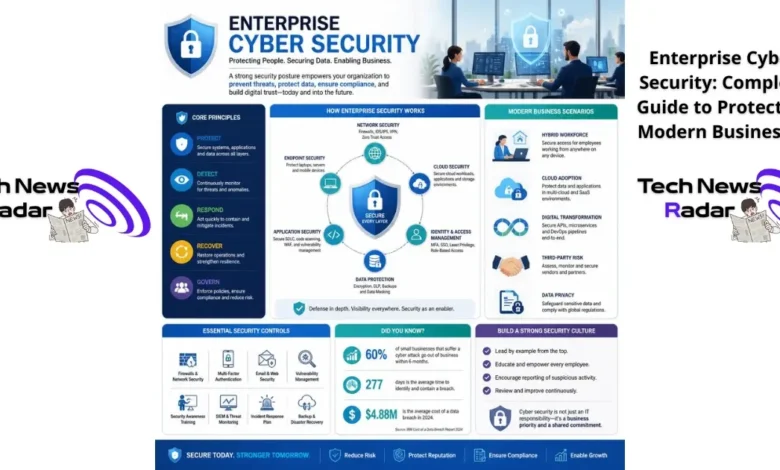
Enterprise cyber security has become a fundamental business requirement as organizations increasingly depend on cloud platforms, connected devices, remote employees, digital payments, artificial intelligence, APIs, and distributed corporate networks. A modern enterprise may operate thousands of endpoints and applications across multiple locations while exchanging sensitive information with customers, employees, suppliers, and business partners.
This growing digital footprint creates a larger attack surface for cybercriminals. Ransomware, phishing, credential theft, insider threats, supply-chain attacks, cloud vulnerabilities, and sophisticated malware can potentially disrupt operations, expose confidential information, and create significant financial and reputational damage.
Enterprise cyber security addresses these risks through a coordinated security architecture designed to protect the organization’s networks, applications, identities, endpoints, cloud environments, data, and critical infrastructure.
Unlike basic cybersecurity practices designed for smaller environments, enterprise security must account for scale, complexity, regulatory requirements, third-party dependencies, and continuous changes in the technology environment.
This guide explains the major components of enterprise cyber security, how modern organizations protect corporate networks, which security solutions matter most, and how businesses can develop a stronger long-term security strategy.
What Is Enterprise Cyber Security?
Enterprise cyber security is the collection of technologies, policies, processes, people, and security controls used to protect a large organization’s digital infrastructure from cyber threats.
The objective is broader than simply preventing unauthorized access.
A comprehensive enterprise security strategy should protect:
- Corporate networks
- Cloud infrastructure
- Endpoints and workstations
- Servers
- Business applications
- Databases
- Customer information
- Employee identities
- Corporate communications
- Intellectual property
- APIs and connected services
- Operational technology
- Third-party integrations
Enterprise environments are particularly challenging because security teams must protect many different systems simultaneously while maintaining availability and productivity.
For example, blocking every external connection might improve security but could make essential business services unusable. Enterprise cyber security therefore requires a balance between protection, accessibility, performance, compliance, and business continuity.
Why Enterprise Cyber Security Matters
Cyberattacks can have consequences far beyond a compromised computer.
A successful attack against an enterprise may interrupt manufacturing, prevent employees from accessing critical systems, expose customer information, disrupt online services, or damage the organization’s reputation.
The financial consequences can include:
- Incident response costs
- Business interruption
- Regulatory penalties
- Legal expenses
- Data recovery costs
- Customer compensation
- Lost revenue
- Security remediation
- Reputation damage
Cybersecurity is therefore increasingly treated as an enterprise risk-management issue rather than simply an IT responsibility.
Executives and boards need visibility into cybersecurity because a major security incident can directly affect business performance.
The Enterprise Cybersecurity Attack Surface
The enterprise attack surface has expanded considerably as organizations adopt cloud computing, remote work, mobile devices, SaaS applications, APIs, and connected infrastructure.
A traditional corporate network may have been relatively centralized.
Modern enterprise infrastructure is often distributed across:
Employees → Endpoints → Corporate Network → Cloud → Applications → APIs → Third Parties → Customers
Every connection introduces potential security considerations.
An organization may have thousands of endpoints but only a small security team. This makes automation, centralized visibility, identity management, and continuous monitoring essential components of enterprise security.
Core Components of Enterprise Cyber Security
A strong enterprise cybersecurity architecture normally consists of multiple security layers rather than a single product.
Network Security
Network security protects communications and infrastructure from unauthorized access, malicious traffic, exploitation, and lateral movement.
Important technologies include:
- Next-generation firewalls
- Intrusion detection systems
- Intrusion prevention systems
- Network segmentation
- Secure remote access
- VPN technologies
- Network traffic monitoring
- DNS security
- Secure web gateways
Network security remains a fundamental layer because attackers often attempt to move through an organization after compromising an endpoint or identity.
Endpoint Security
Every laptop, desktop, smartphone, server, and other connected device can become an entry point for attackers.
Modern enterprise endpoint protection can include:
- Endpoint detection and response
- Antivirus and anti-malware
- Behavioral analysis
- Device control
- Application control
- Exploit prevention
- Automated threat isolation
Endpoint security becomes especially important in organizations with remote and hybrid employees.
Identity and Access Management
Identity has become one of the most important security boundaries in modern enterprises.
Attackers frequently target credentials rather than attempting to exploit the network directly.
Enterprise identity security can include:
- Multi-factor authentication
- Single sign-on
- Privileged access management
- Role-based access control
- Identity governance
- Conditional access
- Passwordless authentication
The objective is to ensure that users have only the access necessary to perform their jobs.
Zero Trust and Enterprise Cyber Security
Zero Trust has become a major architectural approach for modern enterprise security.
The basic principle is that organizations should not automatically trust users, devices, applications, or network locations simply because they are inside the corporate environment.
Instead, access should be continuously evaluated according to factors such as:
- User identity
- Device security
- Application
- Location
- Risk level
- Requested resource
- Authentication status
Zero Trust can reduce the impact of compromised credentials by limiting unnecessary access and reducing opportunities for lateral movement.
It should not be treated as a single product. It is an architectural strategy that integrates identity, access control, network security, endpoint protection, and continuous monitoring.
Cloud Security for Enterprises
Cloud adoption has changed how businesses build and operate infrastructure.
Enterprises may use public clouds, private clouds, hybrid environments, SaaS applications, containers, serverless platforms, and cloud-native databases.
This creates new security responsibilities.
Enterprise cloud security should address:
- Identity and access
- Data encryption
- Cloud configuration
- API security
- Workload protection
- Container security
- Secrets management
- Logging and monitoring
- Compliance
- Data governance
Misconfigured cloud resources can expose sensitive information even when an organization’s traditional network security is strong.
Cloud security must therefore be integrated into the broader enterprise cyber security architecture.
Data Security and Enterprise Information Protection
Data is often the most valuable asset an enterprise possesses.
Organizations may store customer records, financial information, intellectual property, authentication data, employee information, and strategic business documents.
Data security should protect information throughout its lifecycle.
This includes:
Creation → Storage → Processing → Transmission → Backup → Archiving → Deletion
Important controls can include:
- Encryption
- Data loss prevention
- Access controls
- Data classification
- Database security
- Backup protection
- Tokenization
- Key management
- Secure deletion
Data protection becomes particularly important when organizations operate across multiple cloud platforms and geographic regions.
Enterprise Security Solutions
Enterprise security solutions are typically deployed as an integrated ecosystem rather than as isolated products.
A business may use different technologies for different security functions.
| Security Area | Common Enterprise Solution |
|---|---|
| Network | Next-generation firewall |
| Endpoint | EDR/XDR |
| Identity | IAM and MFA |
| Privileged access | PAM |
| Cloud | Cloud security platforms |
| Secure email gateway | |
| Data | DLP and encryption |
| Monitoring | SIEM |
| Threat response | SOAR |
| Vulnerabilities | Vulnerability management |
| Applications | Web application firewall |
| Remote access | Zero Trust network access |
The most effective architecture depends on the organization’s size, industry, infrastructure, regulatory environment, and risk profile.
Buying more security products does not automatically create better security.
Integration and visibility are often more important than the number of tools deployed.
Enterprise Network Security
Enterprise network security focuses specifically on protecting corporate network infrastructure and the traffic moving through it.
A modern enterprise network may connect:
- Headquarters
- Branch offices
- Data centers
- Remote employees
- Cloud environments
- IoT devices
- Partners
- Suppliers
- Customers
Network segmentation is particularly valuable in this environment.
Instead of allowing every device to communicate freely, segmentation limits communication between different parts of the infrastructure.
For example, financial systems should not necessarily have unrestricted access to employee workstations.
Segmentation can reduce the potential damage caused by a compromised endpoint.
Enterprise Network Security Management
Enterprise network security management involves continuously monitoring, configuring, evaluating, and improving the security of corporate network infrastructure.
Security teams may need to manage:
- Firewall policies
- Network segmentation
- Access rules
- VPN connections
- Security alerts
- Network vulnerabilities
- Device configurations
- Traffic patterns
- Security policies
- Compliance requirements
Large environments require centralized management because manually reviewing thousands of security events and configurations is impractical.
Automation and centralized security platforms can help security teams identify anomalies and respond more quickly.
Security Information and Event Management
SIEM platforms provide centralized collection and analysis of security logs.
Enterprise environments generate enormous quantities of events from:
- Firewalls
- Servers
- Endpoints
- Cloud platforms
- Applications
- Identity systems
- Network devices
- Security tools
A SIEM can correlate these events to identify suspicious patterns.
For example, an unusual login followed by privilege escalation and abnormal data access may be more significant when those events are analyzed together than when each event is examined independently.
This makes centralized security monitoring a critical part of enterprise detection and response.
Extended Detection and Response
Modern enterprises increasingly use EDR and XDR technologies to improve threat detection.
EDR, or Endpoint Detection and Response, focuses primarily on endpoint activity.
XDR, or Extended Detection and Response, expands visibility across multiple security layers.
Depending on the platform, XDR may correlate signals from:
- Endpoints
- Identity
- Network
- Cloud
- Applications
The benefit is broader visibility into attacks that cross multiple parts of the enterprise environment.
Ransomware Protection
Ransomware remains one of the most disruptive threats facing businesses.
An attacker may attempt to:
- Gain initial access.
- Steal credentials.
- Escalate privileges.
- Move laterally.
- Disable security controls.
- Encrypt data.
- Steal sensitive information.
- Demand payment.
Enterprise ransomware defense therefore needs multiple layers.
Important controls include:
- MFA
- Endpoint protection
- Network segmentation
- Secure backups
- Privileged access management
- Vulnerability management
- Email security
- Security monitoring
- Incident response planning
Backups should also be protected from unauthorized modification because attackers increasingly target backup systems during ransomware campaigns.
Enterprise Email Security
Email remains a major attack vector because attackers frequently use social engineering to manipulate employees.
Common threats include:
- Phishing
- Business email compromise
- Malicious attachments
- Credential harvesting
- Malware links
- Impersonation
- Invoice fraud
Enterprise email security can combine technical controls with employee awareness training.
Technical protections may include attachment scanning, URL analysis, domain authentication, impersonation detection, and behavioral analysis.
Vulnerability Management
Enterprise environments constantly accumulate vulnerabilities.
Operating systems, applications, network devices, cloud workloads, and third-party software all require regular security assessment.
A mature vulnerability-management program should involve:
Discovery → Prioritization → Remediation → Verification → Continuous Monitoring
Not every vulnerability requires the same response.
Security teams should prioritize vulnerabilities according to factors such as:
- Exploitability
- Asset importance
- Internet exposure
- Business impact
- Available patches
- Active exploitation
- Sensitive data access
Risk-based prioritization is more practical than attempting to treat every vulnerability equally.
Application and API Security
Enterprise applications increasingly communicate through APIs.
This creates additional attack surfaces.
API security should address:
- Authentication
- Authorization
- Rate limiting
- Input validation
- Encryption
- Logging
- API discovery
- Abuse detection
Organizations should know which APIs exist and who can access them.
Unknown or undocumented APIs can create security blind spots.
Application security should also be integrated into the software development lifecycle.
Security testing should begin during development rather than waiting until an application reaches production.
Artificial Intelligence and Enterprise Cyber Security
Artificial intelligence is becoming increasingly relevant to enterprise cybersecurity.
Security teams can use AI-assisted technologies for:
- Threat detection
- Anomaly identification
- Alert prioritization
- Malware analysis
- Security investigation
- Automated response
- Security operations
At the same time, attackers can use AI to improve phishing, social engineering, malware development, reconnaissance, and automated attacks.
This creates an ongoing technology race.
Enterprises should therefore evaluate AI security capabilities while maintaining appropriate human oversight.
AI should augment security teams rather than eliminate the need for experienced cybersecurity professionals.
Quantum Computing and Enterprise Cyber Security
Quantum computing represents a longer-term cybersecurity consideration.
A sufficiently powerful quantum computer could potentially threaten some public-key cryptographic systems used by enterprises.
The most important concern involves algorithms such as RSA and elliptic-curve cryptography, which could theoretically be attacked using quantum algorithms such as Shor’s algorithm.
This creates the possibility of future cryptographic migration.
Organizations should begin understanding their cryptographic dependencies, especially when protecting information that must remain confidential for many years.
Post-quantum cryptography is emerging as an important component of long-term enterprise security planning.
For a deeper examination of this issue, businesses should also evaluate the dedicated guide on quantum computing and enterprise cyber security within this security cluster.
Third-Party and Supply Chain Security
Enterprise cybersecurity does not stop at the organization’s own infrastructure.
Businesses depend on:
- Cloud providers
- Software vendors
- Contractors
- Payment providers
- IT service companies
- SaaS platforms
- Managed security providers
- Hardware manufacturers
A vulnerability in a supplier can become an enterprise security problem.
Third-party security programs should therefore evaluate:
- Vendor security controls
- Data access
- Authentication
- Encryption
- Incident response
- Compliance
- Software security
- Vulnerability management
Organizations should also understand what happens to their data when a vendor experiences a security incident.
Human Factors in Enterprise Cyber Security
Technology alone cannot eliminate enterprise cyber risk.
Employees remain an important component of cybersecurity because attackers frequently exploit human behavior.
Security awareness programs should address:
- Phishing
- Password security
- MFA
- Social engineering
- Suspicious attachments
- Credential protection
- Data handling
- Remote work security
However, organizations should avoid relying entirely on employee awareness.
Strong technical controls should assume that users can make mistakes and provide protection when human error occurs.
Incident Response and Business Continuity
No cybersecurity strategy can guarantee that an organization will never experience an incident.
Therefore, enterprises need a strong incident-response capability.
An incident-response program should define:
- Who investigates incidents
- Who makes critical decisions
- How systems are isolated
- How evidence is preserved
- How customers are notified
- How regulators are contacted
- How operations are restored
- How lessons are incorporated afterward
Business continuity and disaster recovery should complement cybersecurity.
A company that can detect an attack but cannot restore critical systems quickly may still experience severe operational disruption.
How to Build an Enterprise Cyber Security Strategy
A practical enterprise cybersecurity strategy should begin with business risk rather than technology purchases.
Step 1: Identify Critical Assets
Determine which systems and information are essential to the organization.
Step 2: Map the Attack Surface
Identify endpoints, applications, networks, cloud services, APIs, identities, and third-party connections.
Step 3: Assess Cybersecurity Risk
Evaluate threats based on likelihood and potential business impact.
Step 4: Establish Security Priorities
Focus resources on the systems that create the greatest risk.
Step 5: Implement Layered Controls
Combine identity, endpoint, network, cloud, application, and data security.
Step 6: Centralize Visibility
Use logging, monitoring, SIEM, and detection technologies to understand what is happening across the environment.
Step 7: Test the Security Architecture
Use penetration testing, vulnerability assessments, configuration reviews, and simulated incidents to identify weaknesses.
Step 8: Develop Incident Response Plans
Prepare procedures before a major incident occurs.
Step 9: Measure Security Performance
Track meaningful metrics such as:
- Mean time to detect
- Mean time to respond
- Critical vulnerabilities
- Patch coverage
- MFA adoption
- Endpoint coverage
- Backup recovery performance
- Security incidents
Step 10: Continuously Improve
Cybersecurity is not a one-time project.
Threats, technologies, regulations, and business infrastructure continuously change.
How to Choose Enterprise Security Solutions
Organizations should avoid selecting security products solely because they have the largest feature list.
Instead, evaluate solutions according to the organization’s actual requirements.
Important considerations include:
Integration: Can the platform work with existing security infrastructure?
Visibility: Does it provide useful information across the environment?
Automation: Can it reduce repetitive security operations?
Scalability: Can it support the organization’s growth?
Usability: Can security teams operate it effectively?
Performance: Does it introduce unacceptable latency or resource consumption?
Vendor support: Does the supplier provide reliable security updates and incident assistance?
Compliance: Does the solution support applicable regulatory requirements?
Total cost: What are licensing, deployment, training, maintenance, and operational costs?
A smaller integrated security stack can sometimes provide better protection than a large collection of disconnected tools.
Enterprise Cyber Security Best Practices
Organizations looking to strengthen their cybersecurity posture should prioritize several foundational practices.
Use Strong Identity Controls
Implement MFA and enforce least-privilege access.
Segment Critical Systems
Separate sensitive systems from ordinary employee infrastructure.
Keep Software Updated
Patch critical vulnerabilities according to risk and exposure.
Protect Backups
Maintain secure, tested, and appropriately isolated backups.
Monitor Continuously
Detect suspicious activity rather than relying only on periodic security assessments.
Encrypt Sensitive Information
Use appropriate encryption for data at rest and in transit.
Secure Cloud Configurations
Regularly review cloud identities, permissions, storage, workloads, and network configurations.
Test Incident Response
A plan that has never been tested may fail during a real attack.
Assess Third Parties
Understand the security risks created by suppliers and service providers.
Prepare for Emerging Threats
Security strategy should account for AI-driven attacks, quantum computing, supply-chain risks, and other evolving technologies.
The Future of Enterprise Cyber Security
Enterprise cybersecurity will continue to evolve as businesses adopt more connected technologies.
Several trends are likely to shape the future:
- AI-assisted security operations
- Zero Trust architectures
- Passwordless authentication
- Cloud-native security
- Automated threat response
- Extended detection and response
- Post-quantum cryptography
- Identity-centric security
- Continuous security validation
- Automated vulnerability management
The most important shift is that cybersecurity is moving away from a perimeter-only model.
Modern enterprises need security controls that follow users, devices, applications, identities, and data regardless of where they are located.
Enterprise Cyber Security FAQ
What is enterprise cyber security?
Enterprise cyber security is the collection of technologies, policies, processes, and security controls used to protect a large organization’s networks, applications, identities, endpoints, cloud infrastructure, and data from cyber threats.
What is the difference between cybersecurity and enterprise cybersecurity?
Enterprise cybersecurity applies cybersecurity principles to larger and more complex environments. It typically involves more users, devices, applications, locations, third-party connections, regulatory requirements, and security operations.
What are the most important enterprise security solutions?
Important solutions can include firewalls, EDR or XDR, identity and access management, MFA, SIEM, vulnerability management, cloud security, data loss prevention, privileged access management, and Zero Trust technologies.
Why is enterprise network security important?
Enterprise network security protects corporate communications and infrastructure from unauthorized access, malicious traffic, exploitation, and lateral movement after an initial compromise.
What is enterprise network security management?
Enterprise network security management is the ongoing process of configuring, monitoring, maintaining, and improving the security of corporate network infrastructure.
Is Zero Trust part of enterprise cybersecurity?
Yes. Zero Trust is an architectural approach that strengthens enterprise security by continuously evaluating access rather than automatically trusting users or devices based on network location.
How can businesses protect against ransomware?
Businesses should combine MFA, endpoint security, network segmentation, secure backups, vulnerability management, identity controls, email security, continuous monitoring, and tested incident-response procedures.
Is AI a threat to enterprise cybersecurity?
AI can benefit security teams by improving detection and automation, but attackers can also use AI to enhance phishing, social engineering, reconnaissance, and other malicious activities.
Should enterprises prepare for quantum computing?
Yes. Organizations with sensitive information requiring long-term confidentiality should begin understanding their cryptographic dependencies and evaluating post-quantum migration strategies.
Conclusion
Enterprise cyber security is no longer limited to protecting a corporate firewall or installing antivirus software on employee computers.
Modern businesses require a coordinated security architecture covering identity, endpoints, networks, cloud infrastructure, applications, APIs, data, third parties, and human behavior.
The strongest enterprise cybersecurity strategies combine prevention, detection, response, recovery, and continuous improvement.
Organizations should also recognize that cybersecurity is ultimately a business-risk discipline. The objective is not to eliminate every possible threat, which is unrealistic, but to reduce the likelihood and potential impact of attacks while maintaining the availability and integrity of critical business operations.
As enterprise infrastructure continues to expand into cloud platforms, remote environments, AI-powered applications, and interconnected ecosystems, the organizations that build security into their architecture from the beginning will be better positioned to protect their data, customers, employees, and long-term competitive advantage.
Enterprise cyber security is therefore not a single product or one-time project. It is an ongoing strategic capability that must evolve alongside the business and the threat landscape.