Apple iPhone 18 Pro Set to Launch in September 2026 With 2nm Chip and Major Camera Upgrades


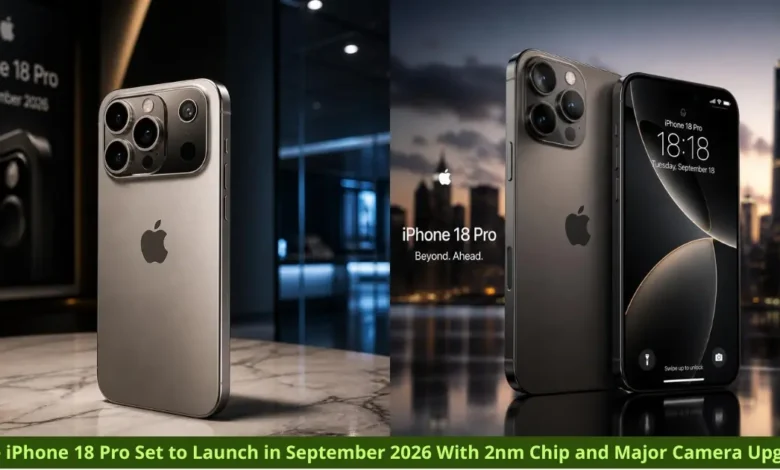
apple iphone 18 pro is shaping up to be one of Apple’s most significant smartphone launches in years, with the company expected to unveil the iPhone 18 Pro and iPhone 18 Pro Max in September 2026 as part of a radically different iPhone release strategy. Unlike previous generations, Apple is reportedly preparing to split its flagship iPhone launches across two seasons, with the premium Pro models arriving in the fall alongside an entirely new foldable iPhone, while the standard iPhone 18 and iPhone 18e are expected to follow in spring 2027. The shift would give Apple a very different product calendar and put greater attention on its most expensive iPhones during the traditional September launch window. MacRumors currently lists the iPhone 18 Pro, iPhone 18 Pro Max and Apple’s first foldable iPhone for September 2026, while the standard iPhone 18 is expected to arrive later.
Apple iPhone 18 Pro Expected to Arrive in September
Apple has not officially announced the iPhone 18 Pro launch date, but the latest reports point to Wednesday, September 9, 2026, as the likely date for the company’s next major iPhone event. Forbes reports that Apple is expected to follow its established September launch pattern, with the announcement potentially taking place on September 9 and the company reportedly planning to open preorders on Friday, September 11, followed by retail availability on Friday, September 18. These dates remain projections rather than confirmed Apple announcements, meaning the final schedule could still change.
The expected September event would be particularly important because Apple is reportedly changing more than just the hardware. For years, Apple has used its fall event to introduce the main iPhone lineup together, allowing customers to choose between standard and Pro models during the same upgrade cycle. The 2026 strategy is expected to break that tradition. Instead, Apple could concentrate its fall event on the iPhone 18 Pro, iPhone 18 Pro Max and its first foldable iPhone, leaving buyers interested in the less expensive standard models to wait until the spring of 2027. That would effectively turn the iPhone into a two-season product family rather than a single annual launch.


Read Also:
Samsung Expands One UI 9 Internal Testing to 49 Devices: Full Galaxy Eligibility Grid
The strategy could also help Apple create more separation between its premium and mainstream products. Rather than having customers compare the latest Pro iPhone directly with a new standard model in September, Apple would have an opportunity to position the Pro models as the headline products of the fall season. The move would make the iPhone 18 Pro more central to Apple’s 2026 hardware story, especially as the company prepares to introduce a new processor architecture, camera technology and potentially a new generation of wireless hardware.
A 2nm A20 Pro Chip Could Be the Biggest Upgrade
One of the most important changes expected inside the apple iphone 18 pro is the transition to a 2-nanometer processor. Reports indicate that Apple’s next-generation A20 Pro chip will be manufactured using TSMC’s first-generation 2nm process, moving the company beyond the 3nm technology used in the A19 Pro generation. MacRumors reports that the iPhone 18 Pro models are expected to become some of the first Apple smartphones using chips manufactured on the 2nm node.
The significance of a smaller manufacturing process goes beyond simply having a new number attached to the processor. Shrinking the transistor fabrication process allows chip designers to place more transistors into a comparable physical area while potentially improving power efficiency and performance. For consumers, that could translate into faster app launches, improved gaming performance, more capable artificial intelligence processing and better battery efficiency.
Current reports suggest that the A20 series could deliver meaningful gains compared with the A19 generation. MacRumors has cited expectations of roughly a 15% performance improvement and potentially around 30% better efficiency, although those figures are based on reports and expectations rather than Apple-confirmed specifications.
The efficiency improvement could ultimately matter more than raw benchmark scores. Smartphone processors have become powerful enough that most users rarely need every ounce of available CPU performance, but improved efficiency can affect everyday battery life. A more efficient chip could allow Apple to maintain high performance while reducing power consumption, potentially giving the iPhone 18 Pro more endurance without requiring a dramatic increase in battery capacity.
The new chip is also expected to play a major role in Apple’s artificial intelligence strategy. Apple has been increasing the importance of on-device processing through Apple Intelligence, and a more powerful Neural Engine combined with greater memory bandwidth could allow future iPhones to handle more AI workloads locally. That could improve responsiveness while reducing the need to send certain tasks to cloud servers.
Another interesting possibility involves the way Apple packages the A20 chip. MacRumors reports that the A20 series could use TSMC’s wafer-level multi-chip module technology, potentially integrating memory more closely with the processor package. If implemented as expected, the approach could improve communication between the processor and memory while helping Apple optimize performance for demanding workloads.
Camera Technology Could Get a Major Mechanical Upgrade
Processing power may be only half of the story. Apple is also expected to introduce a significant camera change with the apple iphone 18 pro, particularly through the addition of a variable-aperture main camera.
The rumored technology would represent a major departure from the fixed-aperture approach Apple has used across its recent Pro iPhones. According to MacRumors, the iPhone 18 Pro and iPhone 18 Pro Max are expected to feature a variable-aperture camera that can physically adjust the size of the lens opening.
That difference could have practical consequences for photography and video. A variable aperture allows a camera to control how much light reaches the sensor. In bright environments, the aperture can potentially close down to help manage exposure, while in darker conditions it can open wider to capture more light. It can also provide greater control over depth of field, giving photographers another way to influence the appearance of an image.
For video creators, the change could be especially interesting. MacRumors notes that one potential benefit is smoother-looking video exposure in outdoor conditions. Instead of relying entirely on electronic exposure adjustments and computational photography, the camera could physically regulate incoming light.
The rumored camera system would also demonstrate how Apple is increasingly combining computational photography with traditional optical controls. Apple has spent years building its image-processing pipeline around the combination of sensors, lenses, machine learning and custom silicon. A variable aperture could give that software more information and control to work with, potentially improving results across a wider range of lighting conditions.
The upgrade could come at a cost, however. According to a report cited by MacRumors, the variable-aperture lens could cost Apple approximately 50% more than the camera component used in the current iPhone 17 Pro main camera.
That additional component cost is one reason analysts and supply-chain watchers are paying close attention to the potential iPhone 18 Pro price. Apple has historically used the Pro models as a showcase for its most expensive technologies, and the introduction of more sophisticated camera hardware could contribute to a higher retail price.
The Design May Change Less Than the Internals
Despite the expected internal upgrades, the iPhone 18 Pro may not look dramatically different from the current generation. Current reports suggest Apple could maintain the overall design language introduced with recent Pro models rather than completely redesigning the phone.
The expected lineup includes a 6.3-inch iPhone 18 Pro and a 6.9-inch iPhone 18 Pro Max, broadly maintaining the display sizes associated with Apple’s current Pro strategy. MacRumors also reports that Apple could reduce the size of the Dynamic Island, although the exact implementation remains uncertain.
A smaller Dynamic Island would be a relatively subtle visual change, but it could indicate that Apple is continuing to work toward reducing the amount of space occupied by front-facing sensors and camera hardware. Apple has been gradually refining the area around the display rather than eliminating it entirely, and the iPhone 18 generation could continue that progression.
There are also reports suggesting that the iPhone 18 Pro could become somewhat thicker. MacRumors recently reported claims that the phone’s aluminum frame and rear camera housing could increase in thickness, with one leak suggesting an overall increase of around 2mm. That information comes from the supply-chain and leak ecosystem rather than Apple itself, so it should be treated cautiously.
A thicker body would not necessarily be a disadvantage. Additional internal space could give Apple more room for batteries, cameras, thermal management components or other hardware. As processors become more powerful and camera systems become more sophisticated, thermal and battery constraints become increasingly important.
Apple Could Introduce Its C2 Modem
The cellular modem is another area where the iPhone 18 Pro could mark an important transition. Reports have suggested that Apple plans to use its next-generation C2 modem in the Pro models, potentially reducing the company’s dependence on Qualcomm for cellular connectivity.
MacRumors has reported that the C2 modem is expected to appear in the iPhone 18 Pro lineup.
Apple has been developing its own modem technology for years, making the C2 potentially significant from a strategic perspective. Designing more of the core technology inside the iPhone could give Apple greater control over hardware and software integration. It could also allow the company to optimize modem behavior more closely with its A-series processors and operating system.
However, modem performance is not something that can be judged simply by looking at a specification sheet. Real-world performance depends on carrier networks, spectrum, signal conditions, power management and regional configurations. Apple would therefore need to demonstrate that its in-house modem can deliver competitive connectivity while maintaining strong efficiency.
iPhone Fold Could Share the Spotlight
Perhaps the biggest change to Apple’s 2026 iPhone strategy is not the iPhone 18 Pro itself but what is expected to launch alongside it.
Apple is widely rumored to be preparing its first foldable iPhone, commonly referred to as the iPhone Fold. MacRumors currently expects the foldable device to arrive alongside the iPhone 18 Pro and iPhone 18 Pro Max in September 2026.
The rumored foldable could have a display measuring approximately 5.5 inches when closed and around 7.8 inches when fully opened. If those specifications prove accurate, Apple would be entering a category that has already been developed by Samsung, Google and several Chinese smartphone manufacturers.
For Apple, however, the challenge would not simply be to release a foldable phone. The company would need to create a product that feels sufficiently refined to justify its premium positioning. Durability, hinge design, display longevity, software optimization and multitasking would all be critical.
The presence of an iPhone Fold could also change the way consumers view the Pro models. Some buyers may consider the iPhone 18 Pro the conventional flagship, while others could see the foldable as the ultimate premium iPhone. Apple would therefore be entering a new phase in which its most expensive models compete not only on camera and processor performance but also on form factor.
Why the iPhone 18 Will Reportedly Be Delayed
The decision to delay the standard iPhone 18 until spring 2027 could be one of the most consequential parts of Apple’s new release strategy.
MacRumors reports that Apple is expected to launch the iPhone 18 Pro and iPhone 18 Pro Max during the fall of 2026, while the standard iPhone 18 and iPhone 18e would arrive in spring 2027.
This would allow Apple to spread its iPhone launches throughout the year rather than introducing every major model at once. From a business perspective, that could give Apple more opportunities to generate attention, maintain consumer interest and distribute manufacturing demand.
For consumers, however, the change could create a more complicated buying decision. Someone looking for a new iPhone in September 2026 may have to choose between paying a premium for an iPhone 18 Pro or Pro Max and waiting several months for the standard iPhone 18.
That could effectively make the fall iPhone event a premium-only upgrade window. Apple would still have the ability to promote the Pro models as the most advanced iPhones available, while the standard models could receive their own marketing push when they arrive in 2027.
Apple iPhone 18 Pro Price Could Start Around $1,199
Pricing is one of the biggest unanswered questions surrounding the apple iphone 18 pro. Current reports have suggested a starting price of around $1,199, which would make the device more expensive than previous Pro models at launch.
That potential increase is particularly notable because Apple has traditionally maintained relatively predictable U.S. pricing for its flagship iPhones. A move to $1,199 would put additional pressure on consumers, especially if storage upgrades continue to push higher-capacity configurations well above the entry-level price.
The rumored price increase could be connected to rising component costs. The A20 Pro chip, more advanced camera hardware and potentially higher memory requirements could all increase Apple’s bill of materials. The reported variable-aperture camera, for example, is expected to be substantially more expensive than the current main-camera lens assembly.
At the same time, the reported $1,199 figure should not be treated as confirmed pricing. Apple has not announced the iPhone 18 Pro, and pricing can change before launch. Regional taxes, storage configurations and currency fluctuations would also affect the final price outside the United States.
What the iPhone 18 Pro Could Mean for Apple
The iPhone 18 Pro is shaping up to be more than a routine annual processor upgrade. If the current reports prove accurate, Apple is preparing several changes at once: a 2nm A20 Pro chip, a variable-aperture camera system, an upgraded modem, possible battery and display improvements, and a dramatically different iPhone release schedule.
The move to 2nm could be particularly important because it establishes the technological foundation for future generations of Apple silicon. MacRumors reports that Apple is expected to remain on the 2nm process for 2027 before moving some high-end chips toward a 1.4nm process in 2028.
That means the iPhone 18 Pro could represent the beginning of a new silicon cycle rather than simply another annual iteration. More efficient processors could enable Apple to push further into on-device AI, advanced photography, gaming and other computationally demanding applications without increasing power consumption at the same rate.
The camera system could be equally influential. Smartphone photography has increasingly relied on computational processing to overcome the physical limitations of small sensors and lenses. By bringing a variable aperture into the system, Apple could be signaling that the next phase of smartphone photography will involve closer integration between mechanical optics and computational photography.
The September Launch Is Still a Prediction
Despite the growing number of reports, it is important to distinguish between credible supply-chain reporting, analyst predictions, leaks and confirmed Apple information.
Apple has not officially announced the iPhone 18 Pro, its final specifications, launch price or September 9 event date as of August 16, 2026. The reported September 9 date comes from forecasting based on Apple’s historical launch patterns and recent reporting, while the September 11 preorder date and September 18 retail availability are also expected dates rather than confirmed details. Forbes currently identifies September 9 as the predicted event date and September 18 as the expected store availability date.
That distinction matters because Apple can change launch schedules, product configurations and pricing before a keynote. Rumored specifications can also change during development, particularly when they originate from supply-chain sources or anonymous leakers.
Still, the broader picture is becoming increasingly consistent across reports. The iPhone 18 Pro and iPhone 18 Pro Max are expected to headline Apple’s fall 2026 iPhone event, while the standard iPhone 18 is reportedly being pushed to spring 2027. The 2nm A20 Pro processor and variable-aperture camera are among the most frequently reported upgrades, and Apple’s first foldable iPhone could make the 2026 launch one of the company’s most important iPhone events in years.
Apple iPhone 18 Pro Could Redefine the 2026 iPhone Lineup
If the current reports are accurate, the apple iphone 18 pro will arrive at a pivotal moment for Apple. The company is not simply preparing another annual upgrade; it appears to be restructuring the iPhone release calendar while simultaneously introducing a new processor manufacturing technology, more sophisticated camera hardware and potentially its own next-generation modem.
The rumored September 9 event would put the iPhone 18 Pro and iPhone 18 Pro Max at the center of Apple’s fall hardware strategy, with the first iPhone Fold potentially sharing the stage. The standard iPhone 18 would then arrive months later, giving Apple two major opportunities to promote new iPhone hardware during the same product cycle.
For consumers, the most meaningful improvements may ultimately come from the combination of technologies rather than any single specification. A more efficient 2nm processor could improve battery life and AI performance, the variable-aperture camera could give photographers greater optical control, and a next-generation modem could strengthen Apple’s control over the iPhone’s internal technology stack.
The biggest question may be whether those upgrades justify a rumored $1,199 starting price. If Apple can deliver noticeable gains in battery life, photography, performance and everyday usability, the higher price could be easier for buyers to accept. If the improvements remain subtle in normal use, consumers may be more inclined to wait for the standard iPhone 18 in 2027.
For now, the iPhone 18 Pro remains an unreleased product surrounded by increasingly detailed reports rather than an officially confirmed device. But with September approaching, the speculation is entering its final stage. If Apple follows the reported schedule, the company could soon reveal whether the 2nm A20 Pro chip, variable-aperture camera, new modem and revised launch strategy are real—and whether the iPhone 18 Pro deserves to be considered one of the most important iPhone upgrades in recent years.
Discover more from Tech News Radar
Subscribe to get the latest posts sent to your email.