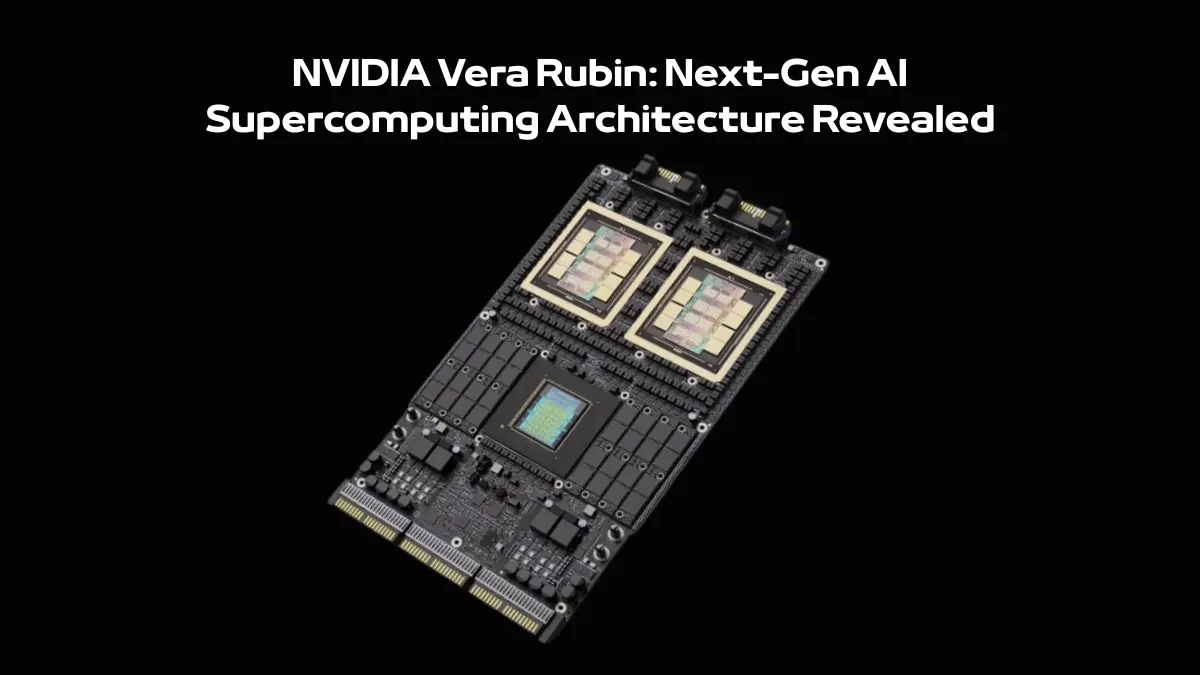
NVIDIA has officially entered full-scale mass production for its highly anticipated next-generation data center platform, NVIDIA Vera Rubin. Purpose-built for the rapidly evolving era of “Agentic AI” and complex reasoning models, this groundbreaking architecture marks the next major leap in AI supercomputing. Named after the legendary American astronomer Vera Rubin, who provided crucial evidence for the existence of dark matter, this platform serves as the direct successor to the Blackwell line, ready to supply global infrastructure networks with unparalleled localized processing power.
Core Architecture: The Seven-Chip Interconnected Ecosystem
The foundation of the NVIDIA Vera Rubin framework relies on a highly integrated hardware and software ecosystem. Built upon the principles of “Extreme Co-design,” the platform introduces seven brand-new, synchronized microchips engineered to operate with maximum workload fluidity:
- The Rubin GPU: Representing a generational shift in deep learning execution, the Rubin GPU is built entirely around next-generation High Bandwidth Memory 4 (HBM4). It delivers an astonishing 50 petaFLOPS of low-precision compute performance (NVFP4), powered by NVIDIA’s advanced 3rd Generation Transformer Engine.
- The NVIDIA Vera CPU: A specialized processor optimized for streaming data traffic management and secure sandboxing environments required for digital autonomous agents. Armed with 88 custom Olympus cores, it provides up to an 80% acceleration boost in software environment orchestration compared to traditional legacy central processors.
- Ultra-Fast Interconnect & Networking: The platform deploys the 6th Generation NVLink interface, offering a staggering bi-directional throughput of 3.6 Terabytes per second (TB/s) per GPU. This framework is reinforced by ConnectX-9 SmartNICs, BlueField-4 DPUs, and Spectrum-X technology powered by Co-Packaged Optics (CPO) to link millions of processing units seamlessly.
Read Also:


Nvidia Agentic AI Era Declared by Jensen Huang in Global Tech Shift
Unprecedented Gains in Power Efficiency and Economic Scalability
The fundamental objective behind the NVIDIA Vera Rubin architecture is to drastically drive down the massive computing overhead associated with running multi-trillion parameter neural networks. NVIDIA achieved this through a radical energy-efficiency redesign:
- 10x Higher Operational Efficiency: The Rubin infrastructure provides a massive 10x increase in inference throughput per watt compared to the previous Blackwell flagships.
- Drastic Token Cost Reduction: The economic expense of generating a “million tokens” has been effectively slashed to 1/10th of legacy costs, making the commercial hosting of colossal mixture-of-experts (MoE) models highly viable for enterprises.
- Accelerated Model Training: Corporate data centers can now train massive frontier models utilizing only a quarter of the physical GPU density required by older clusters, saving technology firms billions of dollars in infrastructure footprint.
Enterprise Deployments and Global Market Availability
NVIDIA, alongside its network of global server manufacturing partners—including Dell, HPE, Lenovo, and Supermicro—is offering tailored infrastructure configurations optimized for hyperscalers and enterprise private clouds:
- Vera Rubin NVL72 System: A completely integrated, single-rack liquid-cooled solution that seamlessly unites 72 Rubin GPUs and 36 Vera CPUs over a high-density NVLink backbone network.
- DGX SuperPOD Architecture: A certified reference blueprint that allows hyper-scale AI organizations to rapidly construct massive “AI Factories,” leveraging automated cluster management software and high-efficiency thermodynamic cooling methods.
Global Availability: Certified hardware systems built on the architectural foundation of the Rubin ecosystem will officially begin shipping to cloud service providers and commercial server networks starting in the second half of 2026.
For continuous, real-time tracking of these hardware breakthroughs, early AI benchmarking, and daily technology deep dives, make sure to keep a close eye on our digital network.
Discover more from Tech News Radar
Subscribe to get the latest posts sent to your email.