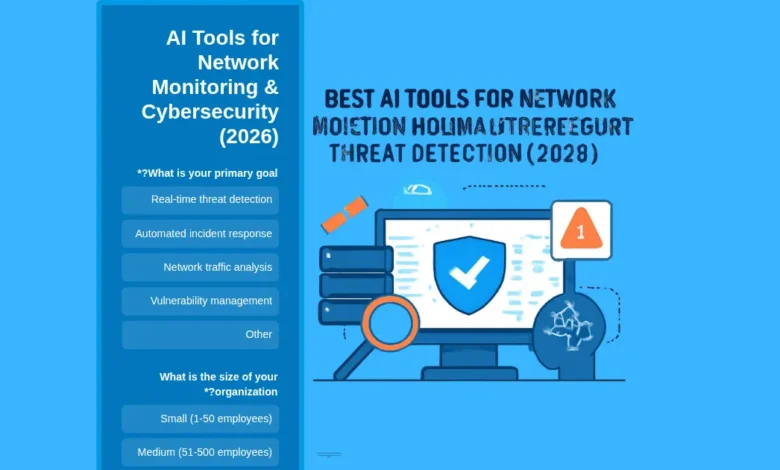
Best AI Tools for Network Monitoring and Cybersecurity Threat Detection (2026). The speed and sophistication of modern cyber threats have made manual network defense obsolete. Cybercriminals now utilize automated scripts and generative AI to find network vulnerabilities, execute zero-day exploits, and deploy ransomware within minutes. To counter these high-speed attacks, security teams and network administrators must fight automation with automation.
Implementing AI tools for network monitoring is the single most effective way to secure data traffic and detect anomalies before they turn into catastrophic data breaches. These next-generation tools continuously analyze network packet telemetry, recognize malicious behavior patterns, and isolate infected nodes autonomously.
This AI Radar evaluation highlights the best artificial intelligence tools for network monitoring and proactive cybersecurity threat detection in 2026.

Why Legacy Network Monitoring Fails in 2026
Traditional network monitoring software relies on signature-based detection. This means the software can only flag a virus or an intrusion if it matches a known signature in an existing database. If a hacker deploys a brand-new, modified strain of malware, legacy tools remain completely blind to it.
AI-driven tools operate via behavioral analysis. By using machine learning models to map out a baseline of your network’s normal daily traffic, the AI instantly flags any deviation—such as an unusual late-night data transfer or a device attempting to access restricted ports—regardless of whether the malware strain has been seen before.
Top 3 AI Cybersecurity Tools for Network Monitoring
Here are the industry-leading AI security platforms that deliver real-time infrastructure defense:
1. Darktrace RESPOND – Best for Autonomous Self-Defense
Darktrace is a pioneer in applying unsupervised machine learning to cybersecurity, acting like an autonomous immune system for your digital network infrastructure.
- How it works: Darktrace builds a deep understanding of your network ecosystem (users, cloud accounts, and connected devices). When it detects a cyber attack, its RESPOND feature takes precise, surgical action to neutralize the threat in real time without disrupting normal business operations.
- Key Use Case: Instantly blocking rogue data exfiltration or stopping ransomware from spreading through local Wi-Fi nodes.
2. Splunk SOAR (with Enterprise Security AI) – Best for Threat Triage
Splunk combines Security Information and Event Management (SIEM) with Security Orchestration, Automation, and Response (SOAR), powered by advanced predictive AI models.
- How it works: Splunk aggregates massive volumes of log data from your routers, firewalls, and cloud servers. Its AI engines filter out the daily noise to pinpoint high-fidelity alerts, automating up to 90% of the investigative workload for security teams.
- Key Use Case: Accelerating incident response times and giving administrators a single, unified radar dashboard of their security posture.
3. Vectra AI (Cognito Platform) – Best for Cloud and Hybrid Networks
Vectra AI focuses heavily on uncovering hidden attacker behaviors across cloud architectures, data centers, and enterprise IoT devices.
- How it works: Vectra utilizes proprietary AI algorithms to detect signs of credential abuse, lateral movement (hackers moving from device to device), and unauthorized remote access. It prioritizes alerts based on actual risk severity, letting you fix critical issues first.
- Key Use Case: Securing hybrid workforces using a mix of home routers, public networks, and centralized corporate servers.
Key AI Security Capabilities: At-a-Glance Comparison
| Tool/Platform | Primary Security Focus | Response Mechanism | Target Infrastructure |
|---|---|---|---|
| Darktrace RESPOND | Autonomous Threat Isolation | Active Self-Healing (Blocks traffic instantly) | Cloud, IoT, and On-Premise Networks |
| Splunk SOAR AI | Log Aggregation & Triage | Automated Playbooks (Guided remediation) | Enterprise IT and Multi-Cloud Ecosystems |
| Vectra AI | Hidden Behavioral Detection | Real-Time Alert Prioritization | Hybrid Cloud and Remote Work Networks |
Implementing AI Security on Smaller Networks
While enterprise-grade tools like Darktrace require substantial IT budgets, smaller businesses and remote professionals can still apply AI-driven defense principles to their networks. Many modern smart routers and mesh systems now include built-in AI security modules (such as Trend Micro’s AI protection or ASUS AiProtection).
These lightweight AI tools block malicious tracking pixels, stop phishing links, and prevent smart home devices from joining infected botnets right at the gateway level. To ensure your hardware is ready to handle these advanced protection layers, read our complete guide on how to secure your home router from cyber attacks to harden your local perimeter before deploying AI software.
Final Thoughts: The Automation Shield
In 2026, cybersecurity is a battle of algorithms. Waiting for a human engineer to spot an anomaly in a network log file means reacting after the damage is already done. By deploying intelligent AI tools for network monitoring, you gain a real-time, proactive radar shield that anticipates, identifies, and neutralizes threats autonomously, keeping your data secure and your uptime stable.
Discover more from Tech News Radar
Subscribe to get the latest posts sent to your email.