Satellite Images Appear to Show Damage at Key Russian Space Communications Sites After Ukrainian Deep-Strike Campaign


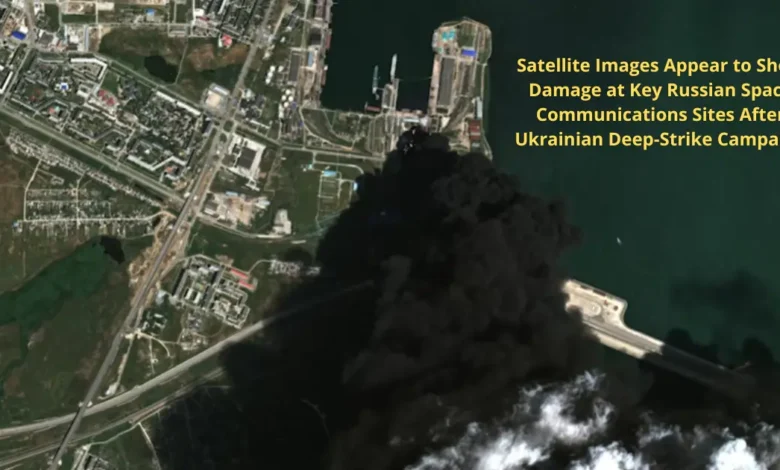
Russian space communications centers. Ukraine’s long-range strike campaign appears to be entering a new phase, with satellite imagery and official statements pointing to an increasing focus on Russia’s military space communications infrastructure rather than its energy facilities alone.
Over the past several days, commercial satellite imagery, open-source intelligence (OSINT) analysis, and statements from Ukrainian officials have centered on two strategically important ground stations—the Dubna Space Communications Center in Russia’s Moscow region and the Vladimir Space Communications Center near Gus-Khrustalny. While Russia has acknowledged large-scale drone attacks targeting multiple regions, it has not publicly confirmed the extent of the reported damage at either facility.
The reported strikes mark a notable evolution in Ukraine’s long-range campaign. Earlier attacks frequently targeted oil refineries, fuel depots, and logistics infrastructure. More recent operations, however, appear increasingly focused on the command, communications, and information systems that underpin Russia’s military operations, suggesting a broader effort to disrupt critical support infrastructure rather than concentrating solely on energy assets.


According to Ukrainian President Volodymyr Zelenskyy, Ukrainian forces struck the Dubna Space Communications Center for a second time within days. Zelenskyy described the facility as a specialized satellite communications hub used for intelligence gathering and coordinating Russian military operations in Ukraine. He also said similar facilities in the Vladimir region had recently been targeted as part of what he characterized as Ukraine’s expanding long-range campaign.
The Dubna facility occupies a particularly important position within Russia’s satellite communications network. Located more than 500 kilometers (roughly 310 miles) from the Ukrainian border, it has historically served as one of Russia’s largest satellite ground stations, supporting government communications, satellite control, and a wide range of civilian and military telecommunications functions. Because of its location deep inside Russian territory, the reported strike also illustrates the increasing reach of Ukraine’s domestically developed long-range drone capabilities.
Read Also:
Is AI Cybersecurity Replacing Human Engineers, or Just Masking System Vulnerabilities?
Separate assessments released by open-source intelligence analysts have drawn even greater attention to the Vladimir Space Communications Center. Commercial satellite imagery published after the reported attack appears to show significant structural damage across multiple sections of the complex, although independent verification of every reported impact remains difficult due to the wartime environment.
According to analyses based on before-and-after satellite imagery, one of the most heavily affected structures appears to be the site’s primary 25-meter satellite antenna. Additional imagery also appears to indicate damage to the facility’s main hardware and software complex, including buildings believed to house satellite modem systems, multiplexers, central switching equipment, and fiber-optic distribution infrastructure. If confirmed, damage to these systems could require substantially longer recovery times than repairs involving exterior antenna structures alone because much of the equipment is highly specialized and not easily replaced.
Military analysts note that ground stations such as Dubna and Vladimir perform functions extending well beyond conventional satellite communications. They act as critical nodes connecting satellites with terrestrial command networks, enabling secure communications, intelligence collection, satellite control, and the transmission of operational data across military formations. Disruptions at these facilities could therefore affect multiple layers of military communications rather than a single isolated capability, although the precise operational impact has not been publicly quantified.
Russia’s Ministry of Defense confirmed that hundreds of Ukrainian drones targeted Russian territory during the latest wave of attacks, saying air defenses intercepted hundreds of unmanned aircraft across numerous regions, including the Moscow area. Moscow Mayor Sergey Sobyanin also reported repeated drone activity around the capital. However, Russian authorities did not publicly confirm the specific damage described by Ukrainian officials at the satellite communications facilities. State media instead reported that emergency crews responded to the incidents while communications services continued operating after earlier attacks.
The growing role of commercial satellite imagery has become one of the defining features of modern warfare. Companies such as Maxar Technologies and Planet Labs, together with independent OSINT researchers, now provide imagery that allows analysts around the world to assess battlefield developments far beyond official government statements. Although such imagery cannot always determine the operational status of highly classified facilities, it often provides the first independent visual evidence supporting—or challenging—claims made by the warring parties.
The apparent shift toward targeting satellite communications infrastructure also reflects the changing nature of contemporary conflict. Modern militaries rely heavily on interconnected command-and-control networks, secure satellite communications, intelligence platforms, and digital battlefield management systems. As a result, disabling ground infrastructure that links these systems together may have broader strategic implications than damaging conventional industrial facilities alone.
Whether these latest strikes produce lasting operational effects remains unclear. Assessing the true impact on military communications will likely require weeks or even months as additional imagery, official disclosures, and independent analyses emerge. Nevertheless, the reported attacks underscore how the conflict is increasingly extending beyond traditional military targets into the sophisticated communications infrastructure that supports twenty-first-century warfare.
For defense observers, the latest developments may represent more than another successful drone operation. They highlight a broader transformation in the war itself—one in which satellites, communications hubs, and digital command networks are becoming as strategically significant as airfields, ammunition depots, and fuel infrastructure.
Discover more from Tech News Radar
Subscribe to get the latest posts sent to your email.