Quantum Computing and Enterprise Cyber Security: What Businesses Need to Know


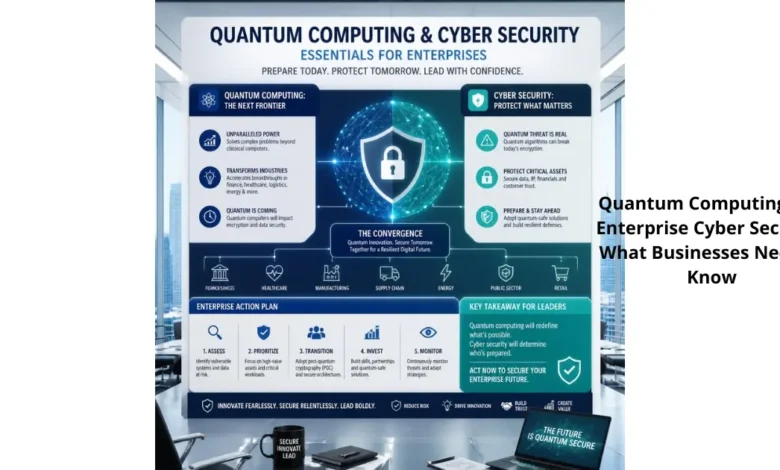
Quantum computing and enterprise cyber security are becoming increasingly connected as businesses prepare for a future in which conventional cryptographic systems could face new and more sophisticated threats. Although large-scale, fault-tolerant quantum computers are not yet capable of breaking modern enterprise encryption, the potential impact on corporate cybersecurity is significant enough that organizations cannot afford to ignore it.
Modern enterprises depend on cryptography to protect customer information, financial records, intellectual property, employee credentials, cloud workloads, digital communications, APIs, VPN connections, and authentication systems. Much of this infrastructure relies on mathematical problems that are extremely difficult for conventional computers to solve.
Quantum computing introduces a fundamentally different computational model. A sufficiently powerful quantum computer could potentially solve certain mathematical problems far more efficiently than a classical computer, creating serious implications for public-key cryptography and digital signatures.


For businesses, this does not mean that quantum computers will suddenly destroy all encryption. Instead, the quantum threat creates a long-term migration challenge. Enterprises need to understand where vulnerable cryptographic systems are being used, determine which information requires long-term protection, and prepare their infrastructure for post-quantum security.
How Does Quantum Computing Affect Enterprise Cyber Security?
Quantum computing could affect enterprise cyber security primarily by threatening some of the public-key cryptographic algorithms used to protect digital communications, identities, certificates, and transactions.
Traditional cybersecurity relies heavily on cryptographic systems such as RSA and elliptic-curve cryptography. These systems are considered secure because solving their underlying mathematical problems with conventional computers requires enormous amounts of computational power.
Quantum computing changes that assumption.
The most important quantum algorithm in this context is Shor’s algorithm. In theory, a sufficiently powerful quantum computer using Shor’s algorithm could efficiently factor large integers and solve discrete logarithm problems. Those capabilities could undermine cryptographic systems that depend on the difficulty of those mathematical problems.
For an enterprise, the consequences could extend across multiple layers of the technology environment.
| Enterprise System | Potential Quantum Impact |
|---|---|
| TLS certificates | Public-key cryptography may require replacement |
| VPNs | Existing key-exchange mechanisms may become vulnerable |
| Digital signatures | Authentication and software signing could be affected |
| Identity systems | Public-key authentication mechanisms may require migration |
| APIs | Encrypted communications could require quantum-resistant methods |
| Cloud platforms | Cryptographic dependencies must be evaluated |
| Data archives | Previously captured encrypted information could face future decryption |
| Enterprise applications | Embedded cryptographic libraries may need upgrades |
The critical issue is not simply whether quantum computers can break encryption today. It is whether organizations can migrate their cryptographic infrastructure before quantum capabilities become a practical threat.
Why Quantum Computing Matters to Enterprise Cybersecurity
Enterprise cybersecurity is increasingly dependent on cryptography.
Businesses use encryption and digital signatures throughout their technology ecosystems, often without having a complete inventory of where cryptographic algorithms are implemented.
A large enterprise could have thousands of applications, servers, databases, certificates, APIs, mobile applications, network devices, cloud services, and third-party integrations.
Some systems may use cryptography directly, while others depend on encryption through operating systems, cloud platforms, security appliances, or software libraries.
This creates a major visibility challenge.
An organization cannot effectively prepare for quantum threats if it does not know which cryptographic technologies are protecting its infrastructure.
Quantum readiness therefore begins with cryptographic visibility.
Security teams need to understand:
- Which applications use RSA.
- Where elliptic-curve cryptography is deployed.
- Which systems depend on public-key certificates.
- How VPNs establish secure connections.
- Which APIs use public-key authentication.
- Where digital signatures are required.
- Which cloud services manage encryption.
- How third-party vendors handle cryptography.
- Which archived datasets require long-term confidentiality.
This inventory becomes the foundation for an enterprise quantum-security strategy.
The Quantum Threat to RSA and Elliptic-Curve Cryptography
RSA and elliptic-curve cryptography are deeply embedded in modern digital infrastructure.
RSA security depends on the computational difficulty of factoring large numbers. Elliptic-curve cryptography relies on the difficulty of solving specific mathematical problems involving elliptic curves.
Classical computers face enormous challenges when attempting to break properly implemented cryptographic systems using conventional brute-force techniques.
Quantum computers could change this situation.
Shor’s algorithm provides a theoretical method for solving the mathematical problems underlying RSA and elliptic-curve cryptography much more efficiently on a sufficiently capable quantum computer.
This is why public-key cryptography is one of the most important areas of concern in quantum cybersecurity.
However, the threat should not be exaggerated.
A theoretical quantum algorithm is not the same as a practical attack against today’s enterprise infrastructure. Building a sufficiently powerful, fault-tolerant quantum computer capable of attacking large cryptographic keys remains an enormous engineering challenge.
The cybersecurity challenge is that enterprise migration also requires significant time.
The “Harvest Now, Decrypt Later” Risk
One of the most important reasons businesses should think about quantum security before large-scale quantum computers become available is the harvest now, decrypt later strategy.
The basic concept is straightforward.
An attacker could potentially collect encrypted information today and store it without being able to decrypt it immediately. If quantum computing eventually becomes powerful enough to compromise the cryptographic mechanism protecting that information, the attacker could attempt to decrypt the previously captured data.
This creates a particularly serious problem for information with a long confidentiality lifetime.
For example, an enterprise may possess:
- Intellectual property
- Financial records
- Strategic business plans
- Research and development data
- Government-related information
- Customer records
- Legal documents
- Proprietary source code
- Sensitive communications
- Trade secrets
Some of this information may remain valuable for a decade or longer.
Consequently, organizations should not evaluate quantum risk solely according to whether today’s systems can be broken today.
They should also ask:
How long must this information remain confidential?
That question can reveal risks that traditional cybersecurity assessments may overlook.
What Is Post-Quantum Cryptography?
Post-quantum cryptography, often abbreviated as PQC, is one of the primary technologies being developed to address the quantum threat.
Post-quantum cryptographic algorithms are designed to provide security against both conventional computers and sufficiently powerful quantum computers.
The objective is not to make existing encryption stronger through larger keys alone. Instead, post-quantum cryptography uses mathematical approaches designed to resist known quantum attacks.
For enterprises, adopting post-quantum cryptography is likely to become a gradual infrastructure migration rather than a single software update.
Organizations may need to modify:
- Applications
- Certificate infrastructures
- Identity systems
- Network protocols
- VPN technologies
- Cloud services
- Hardware security modules
- Security appliances
- Digital-signature systems
- Software-update mechanisms
The complexity of this transition is one reason businesses should begin understanding their cryptographic dependencies well before a cryptographically relevant quantum computer becomes available.
Why Enterprises Need Cryptographic Agility
One of the most important principles for future enterprise cybersecurity is cryptographic agility.
Cryptographic agility means designing systems so that cryptographic algorithms can be replaced without completely rebuilding the underlying technology architecture.
This is particularly important because organizations cannot predict exactly how cryptographic standards will evolve over the next decade.
An enterprise application developed today may still be operating many years from now.
If its cryptographic implementation is deeply embedded in the application architecture, replacing the algorithm later could become expensive and disruptive.
A cryptographically agile architecture makes it easier to:
- Replace vulnerable algorithms.
- Introduce new cryptographic standards.
- Test different security mechanisms.
- Respond to newly discovered vulnerabilities.
- Adapt to regulatory requirements.
- Reduce the cost of future cybersecurity migrations.
For large organizations, cryptographic agility should therefore become an architectural requirement rather than an optional feature.
How to Prepare an Enterprise Network for Quantum Threats
Preparing an enterprise network for quantum threats requires more than purchasing a new security product.
The first stage should be discovery.
1. Create a Cryptographic Inventory
Security teams should identify every major location where cryptography is used.
The inventory should include:
- RSA
- ECC
- TLS
- VPN protocols
- Digital certificates
- Digital signatures
- Public-key infrastructure
- Encryption libraries
- Hardware security modules
- Cloud encryption
- Identity infrastructure
- Third-party applications
This process helps establish the organization’s cryptographic attack surface.
2. Classify Data According to Its Security Lifetime
Not all enterprise data has the same value.
A public webpage may require little confidentiality, while an unpublished acquisition strategy may need protection for decades.
Organizations should therefore classify information according to how long it needs to remain confidential.
Long-lived sensitive information deserves particular attention because of the harvest-now-decrypt-later risk.
3. Identify Legacy Systems
Legacy infrastructure can become one of the biggest obstacles to quantum migration.
Older applications may use cryptographic libraries that are difficult to replace. Some operational technology and embedded systems may remain in service for many years.
Organizations should identify systems that:
- Cannot easily be upgraded.
- Depend on outdated cryptographic libraries.
- Use hard-coded cryptographic algorithms.
- Have limited vendor support.
- Cannot support modern security protocols.
These systems should receive higher priority during quantum-readiness planning.
4. Test Post-Quantum Technologies
Enterprises should evaluate post-quantum cryptography in realistic environments.
Testing should examine:
- Application performance
- Key sizes
- Certificate sizes
- Network latency
- Compatibility
- Hardware requirements
- CPU and memory consumption
- Vendor support
- Interoperability
A cryptographic algorithm that works in a laboratory environment may behave differently when deployed across a large corporate network.
5. Review Vendor Roadmaps
Enterprises rarely control their entire technology stack.
Cloud providers, security vendors, identity platforms, software companies, and hardware manufacturers all influence cryptographic security.
Security teams should therefore ask vendors:
- What is your post-quantum strategy?
- Which products currently support post-quantum cryptography?
- Which products are on the migration roadmap?
- How will existing certificates be handled?
- Will legacy systems remain supported?
- Can cryptographic algorithms be changed without replacing the product?
Vendor transparency will become increasingly important as quantum readiness moves from research into enterprise implementation.
Quantum Computing and Enterprise Cloud Security
Cloud computing makes enterprise cybersecurity more complex because organizations often operate across multiple platforms and providers.
A modern company may use several cloud services simultaneously while connecting them to internal data centers, SaaS applications, remote employees, APIs, and third-party systems.
Cryptographic dependencies can exist throughout this architecture.
Organizations should examine encryption associated with:
- Data at rest
- Data in transit
- Cloud storage
- APIs
- Identity authentication
- Key management
- Database services
- Virtual private networks
- Cloud-native applications
A company could successfully migrate its internal infrastructure to quantum-resistant cryptography while leaving critical third-party cloud connections dependent on vulnerable technologies.
Quantum readiness therefore requires a supply-chain perspective.
Quantum Computing and Zero Trust Security
Quantum preparedness should also be considered alongside Zero Trust security.
Zero Trust architecture is based on principles such as continuous verification, least-privilege access, strong identity controls, and network segmentation.
These principles do not eliminate the quantum threat, but they can reduce the potential consequences of a successful compromise.
For example, if an attacker gains access to a credential or compromises a cryptographic mechanism, strong segmentation can make it harder to move laterally across the enterprise network.
Likewise, strong identity controls can reduce reliance on a single security mechanism.
This means quantum readiness should become part of a broader enterprise cyber security architecture that includes:
- Identity security
- Endpoint protection
- Network segmentation
- Cloud security
- Data protection
- Access control
- Security monitoring
- Incident response
Organizations seeking comprehensive protection should evaluate these capabilities as interconnected components of their overall enterprise cyber security solutions strategy.
Does Quantum Computing Break All Encryption?
No.
This is an important distinction.
Quantum computing does not mean that every encryption technology becomes useless.
The greatest theoretical concern involves public-key cryptography based on mathematical problems that can be targeted by quantum algorithms such as Shor’s algorithm.
Symmetric encryption and cryptographic hashing face different considerations.
Grover’s algorithm, for example, provides a theoretical quadratic speedup for certain brute-force searches. This changes the security margin of some symmetric cryptographic systems, but it is fundamentally different from the threat that Shor’s algorithm presents to RSA and elliptic-curve cryptography.
Therefore, businesses should avoid simplistic claims that quantum computers will “break all encryption.”
The more accurate conclusion is that quantum computing could undermine important cryptographic mechanisms and force enterprises to migrate toward quantum-resistant alternatives.
Quantum Computing Is a Business Risk, Not Just an IT Risk
The quantum threat extends beyond the cybersecurity department.
It can affect:
- Business continuity
- Intellectual property
- Regulatory compliance
- Customer trust
- Data governance
- Long-term information security
- Supply-chain security
- Corporate reputation
Consider a technology company whose competitive advantage depends on proprietary research.
If sensitive encrypted research is stolen today and successfully decrypted years later, the company could lose its competitive advantage even though its cybersecurity infrastructure appeared secure at the time of the original breach.
This illustrates why quantum preparedness should be incorporated into enterprise risk management.
Boards and executives do not necessarily need to understand the mathematical details of quantum algorithms.
They do, however, need to understand the business question:
Can our organization continue protecting sensitive information if the cryptographic assumptions behind today’s security systems change?
A Practical Quantum Cybersecurity Roadmap for Businesses
Enterprises can approach quantum readiness in phases.
Phase One: Discovery
Start by identifying cryptographic dependencies across the organization.
Create an inventory of:
- Algorithms
- Certificates
- Applications
- Databases
- APIs
- Network infrastructure
- Cloud services
- Identity systems
- Third-party integrations
Phase Two: Risk Assessment
Prioritize systems according to:
- Data sensitivity
- Confidentiality lifetime
- Business importance
- Regulatory requirements
- Technology age
- Migration difficulty
- Vendor support
High-value systems containing long-lived sensitive information should generally receive greater attention.
Phase Three: Testing
Begin testing post-quantum technologies in controlled environments.
Hybrid approaches may also become relevant during migration because organizations may need to support both conventional and post-quantum cryptographic mechanisms during the transition.
Phase Four: Migration
After testing and validation, organizations can begin replacing vulnerable cryptographic dependencies.
Migration should be coordinated with application development, infrastructure, cloud operations, identity teams, procurement, and cybersecurity.
Phase Five: Continuous Monitoring
Quantum technology is evolving rapidly.
Organizations should continuously monitor:
- Quantum computing capabilities
- Cryptographic research
- Security standards
- Regulatory developments
- Vendor roadmaps
- New cryptographic vulnerabilities
Quantum readiness should therefore be treated as an ongoing cybersecurity program rather than a one-time project.
What Enterprise Security Teams Should Do Now
Businesses do not necessarily need to replace every cryptographic system immediately.
A more practical approach is to begin preparing.
Security leaders should:
- Build a cryptographic inventory.
- Identify RSA and ECC dependencies.
- Classify long-term sensitive data.
- Identify vulnerable legacy systems.
- Review cloud cryptographic dependencies.
- Ask vendors about post-quantum roadmaps.
- Test post-quantum cryptographic technologies.
- Develop cryptographic agility requirements.
- Include quantum risk in enterprise cybersecurity assessments.
- Create a long-term migration strategy.
These steps can significantly improve an organization’s ability to respond when quantum-resistant cryptography becomes necessary.
The Future of Quantum Computing and Enterprise Cyber Security
Quantum computing is unlikely to transform enterprise cybersecurity overnight.
Instead, the industry is likely to experience a gradual transition in which organizations discover cryptographic dependencies, test new algorithms, update infrastructure, and migrate toward quantum-resistant systems.
The businesses that prepare early will have a significant advantage.
They will have more time to identify legacy systems, negotiate with vendors, test new technologies, protect long-lived data, and reduce the operational disruption associated with cryptographic migration.
The most important lesson is that quantum cybersecurity is not simply about waiting for a future quantum computer.
It is about preparing today’s enterprise architecture for tomorrow’s cryptographic requirements.
FAQ About Quantum Computing and Enterprise Cyber Security
How does quantum computing affect enterprise cyber security?
Quantum computing could threaten certain public-key cryptographic systems used by enterprises for encryption, authentication, certificates, and digital signatures. Organizations can reduce this future risk by adopting post-quantum strategies and improving cryptographic agility.
Can quantum computers break RSA?
A sufficiently powerful fault-tolerant quantum computer could theoretically use Shor’s algorithm to attack RSA by efficiently factoring large integers. However, practical quantum systems capable of performing such attacks at enterprise-relevant key sizes do not currently exist.
What is post-quantum cryptography?
Post-quantum cryptography refers to cryptographic algorithms designed to resist attacks from both classical and quantum computers.
What does “harvest now, decrypt later” mean?
It describes the possibility of collecting encrypted information today and storing it until future computing capabilities make decryption possible. This is particularly concerning for information that must remain confidential for many years.
Should companies start preparing for quantum cybersecurity now?
Yes. Even if practical quantum attacks remain years away, enterprise cryptographic migration can take considerable time. Inventorying cryptographic dependencies and developing a migration strategy can reduce future risk.
Does quantum computing make cybersecurity obsolete?
No. Quantum computing changes specific aspects of cryptography but does not eliminate the need for cybersecurity. Identity security, endpoint protection, network segmentation, cloud security, monitoring, access control, and incident response will remain essential.
Conclusion
Quantum computing and enterprise cyber security represent an increasingly important intersection between emerging technology and corporate risk management.
The biggest challenge for businesses is not simply determining when quantum computers will become powerful enough to threaten existing cryptography. The more immediate challenge is understanding how deeply current cryptographic systems are embedded throughout enterprise infrastructure and how long it will take to replace them.
Organizations that begin with cryptographic discovery, data classification, vendor assessments, post-quantum testing, and cryptographic agility will be better prepared for the transition.
Quantum computing may still be developing, but enterprise cybersecurity planning cannot afford to stand still.
The companies that prepare before the threat becomes urgent will have more options, more time, and a much lower migration risk.
Discover more from Tech News Radar
Subscribe to get the latest posts sent to your email.