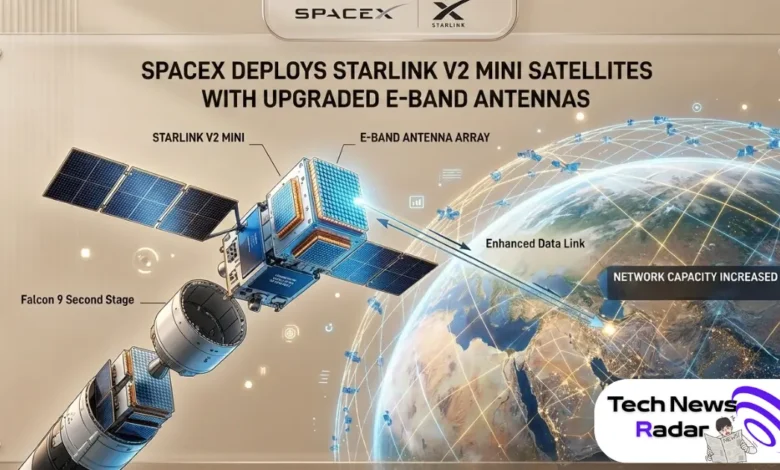
SpaceX Deploys V2 Mini Satellites with Upgraded E-Band Antennas for Starlink Network to officially expand its orbital constellation, launching a savage hardware offensive designed to drastically augment the platform’s backhaul capacity and crush surging data congestion across North America. The core technical breakthrough of this newly deployed aerospace hardware lies inside its advanced communications payload which discards legacy frequency limits to integrate highly sophisticated E-band antennas operating directly within the ultra-dense 70 to 80 GHz spectrum. By unlocking these wider channel bandwidths, each spacecraft delivers up to four times more throughput compared to first-generation hardware units, translating into a highly resilient low Earth orbit grid that maintains peak gigabit performance and unyielding spectral efficiency even during high-congestion hours.
While designated as mini variants, these satellites are substantially larger and more capable than legacy v1.5 hardware, forcing a complete re-engineering of the vehicle’s chassis, power matrices, and orbital propulsion systems. To fuel these power-hungry millimeter-wave antennas, SpaceX engineers deployed massive dual solar wings spanning a total surface area that completely outclasses older variants, paired with high-efficiency Argon Hall electric thrusters that generate massive specific impulse to maintain precise low Earth orbit positioning. Furthermore, ground communication is managed via ultra-dense phased array blocks that radically sharpen beam-forming capabilities, systematically minimizing signal degradation caused by atmospheric interference and weather bottlenecks.
To learn what Starlink is, read our article.[What Is Starlink and How Does It Work?]
Read Also:


Apple TV 4K 2026 Leaks Next-Gen Console-Grade Silicon and Siri 2.0 Smarthome Upgrade Exposed!
From a pure hardware infrastructure perspective, this deployment directly targets and eradicates the ultimate bottleneck of satellite-delivered broadband by fundamentally upgrading the link between active spacecraft and regional ground stations through specialized spectrum optimization. This orbital scaling project prepares the network for its next phase of consumer terminal hardware, ensuring that users equipped with standard and high-performance Starlink dishes experience fewer packet drops and a flawlessly stable connection pipeline capable of supporting bandwidth-heavy operations like real-time data streaming without experiencing network-enforced throttle limits, proving that when custom aerospace engineering maps perfectly onto unthrottled spectrum architecture, traditional telecom networks are left completely in the dust.
Discover more from Tech News Radar
Subscribe to get the latest posts sent to your email.